Qualcomm's NASCAR Naming Rights Deal Rewrites the Tech-Motorsport Playbook
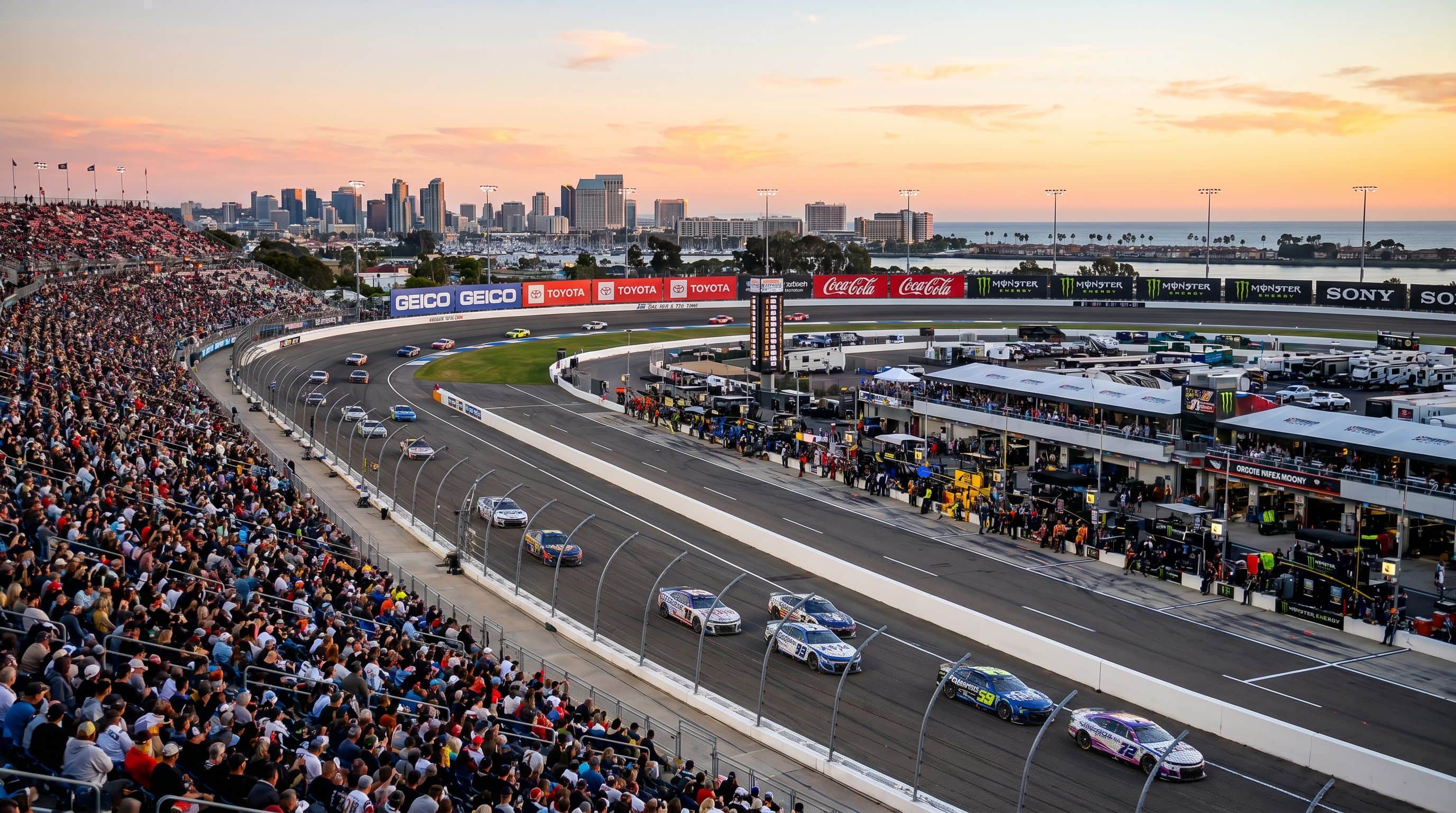
Qualcomm just secured circuit naming rights for NASCAR's inaugural San Diego race weekend, and if you're paying attention to where tech sponsorship dollars are flowing, this one deserves a close read. As reported by Sports Business Journal, the deal pairs Qualcomm with Anduril — the defense AI startup that holds title sponsorship for the races themselves — creating a dual-sponsor architecture that we think signals something much bigger than another logo on a wall. The financial terms weren't disclosed, but circuit naming rights for a marquee NASCAR weekend typically fall in the $3M–$8M range depending on market size, broadcast inventory, and activation scope. What makes this Qualcomm sponsorship notable isn't just the money. It's the model.
Beyond standard branding, Qualcomm will deploy its intelligent computing and connectivity software to enhance the on-site fan experience — making this a deal where the sponsor literally becomes the infrastructure of the event itself. That's a fundamentally different value proposition than buying signage and hoping someone remembers your name.
Why This Matters: The Quiet Death of Passive Naming Rights
For decades, naming rights deals followed a simple formula: write a large check, get your name on the building (or the circuit, or the series), then rely on broadcast mentions and signage impressions to justify the spend. The Qualcomm–NASCAR deal breaks that model in ways the industry should be studying.
Here's the shift: Qualcomm isn't buying awareness. They're buying a proving ground.
When a chipmaker deploys its connectivity stack at a live event with 80,000+ attendees and millions of broadcast viewers, they're not just getting logo exposure — they're generating a real-time case study for their enterprise sales team. Every seamless data handoff, every low-latency video stream, every connected activation becomes a proof point that Qualcomm's team can reference in boardrooms from Seoul to Stuttgart.
This matters because it reprices what naming rights are actually worth. If the sponsor extracts enterprise pipeline value on top of traditional brand impressions, the effective ROI math changes dramatically — and so should the deal structure.
We've been tracking this convergence for a while. The most sophisticated brands we see through SponsorFlo's platform aren't asking "how many eyeballs will we get?" They're asking "what operational or commercial proof can we generate through this partnership?" The Qualcomm deal is the highest-profile example yet of that mentality hitting motorsports.
The Dual-Sponsor Architecture: A Framework Worth Naming
Let's talk about the structure itself, because the Qualcomm + Anduril pairing introduces a model we're calling The Parallel Equity Stack.
Traditionally, properties sell naming rights as a hierarchy: title sponsor on top, presenting sponsors below, then a tier of official partners, and so on. It's a pyramid. Everyone knows where they stand, and frankly, everyone below the title sponsor feels a little shortchanged.
The San Diego race is doing something different. Anduril owns the race title. Qualcomm owns the circuit name. These aren't hierarchical — they're parallel. Two different brands, two different asset classes, two different audience touchpoints, operating at equivalent prestige without one subordinating the other.
This matters for three reasons:
- It unlocks more premium inventory. Instead of one title sponsor at $10M+, you can sell two $5M–$8M deals that feel equally premium to each buyer. Total revenue goes up.
- It reduces category conflict. Anduril (defense AI) and Qualcomm (mobile computing/connectivity) are adjacent but not competitive. The property gets two tech sponsors without either feeling diluted.
- It creates narrative depth for broadcast. Announcers saying "the Anduril [Race Name] at the Qualcomm [Circuit Name]" gives both brands repeated organic mentions — something that would feel forced with a traditional presenting sponsor.
We predict this model will spread quickly. Properties with distinguishable sub-assets — the venue name vs. the event name vs. the broadcast name — can now sell each layer independently to non-competing sponsors. It's not unlike what European football has done for years with stadium naming, kit sponsorship, and sleeve partnerships all going to different brands. But in American motorsports, this level of structural creativity is relatively new.
For sponsorship managers evaluating similar structures, this is exactly where tools like SponsorFlo's agreement extraction and tracking features become critical. When you're running parallel equity stacks with overlapping deliverables and separate sponsors who each need distinct ROI reporting, manual spreadsheet tracking becomes a liability, not a workflow.
What Qualcomm Actually Gets: The Infrastructure Sponsor Advantage
Let's unpack what "deploying intelligent computing and connectivity software to enhance the fan experience" actually means in practice, because the press release language obscures the strategic genius here.
Based on what we've seen from similar tech-infrastructure sponsorships (Cisco's deal with the NFL, Verizon's 5G activations at Super Bowl venues, Intel's work in the Olympic Games), Qualcomm is likely providing some combination of:
- Private 5G or Wi-Fi 6E network infrastructure across the circuit grounds
- Edge computing nodes powering real-time data overlays for fans (think: live timing, driver telemetry, AR experiences accessible via phone)
- Connected venue technology — smart wayfinding, mobile ordering acceleration, congestion management via IoT sensors
- Broadcast enhancement tools — on-device second-screen experiences powered by Qualcomm's Snapdragon platform
The value proposition to Qualcomm isn't just that 80,000 fans see their logo. It's that 80,000 fans use their technology without knowing it — and then Qualcomm's enterprise sales team can say to every stadium operator, event producer, and smart city planner in the world: "Here's what our stack did at a live, high-density NASCAR event. Want the same results?"
We call this the Invisible Activation Premium — the idea that the most valuable sponsorship activations are the ones the end consumer doesn't consciously attribute to the sponsor, but which generate measurable operational outcomes the sponsor can monetize elsewhere.
The Invisible Activation Premium: When a sponsor's technology becomes the invisible backbone of an event experience, the brand extracts dual value — consumer goodwill from a seamless experience AND enterprise proof-of-concept data that accelerates B2B sales cycles. The sponsorship fee becomes, in effect, a subsidized R&D deployment.
This is a profoundly different ROI model than traditional sponsorship, and it requires profoundly different measurement approaches. You can't evaluate an Invisible Activation deal using CPM benchmarks or social media impressions alone. You need to track enterprise pipeline sourced from the event, demo requests generated, and partner referrals — metrics that live in CRM systems, not media monitoring dashboards.
This is one of the reasons we built SponsorFlo's ROI analytics to accommodate custom KPI definitions rather than forcing every deal into the same impressions-and-engagement template. Not every sponsorship is trying to do the same thing, and the measurement framework needs to reflect that.
NASCAR's Sponsor Roster Is Telling Us Something About the Next Decade
Zoom out from the Qualcomm deal and look at the broader sponsor composition for this San Diego event. Anduril — a defense AI company. Qualcomm — a semiconductor and connectivity firm. These are not Budweiser and STP.
NASCAR has been on a deliberate trajectory to diversify its sponsor base beyond traditional automotive aftermarket, beer, and consumer packaged goods brands. And it's working. Over the past four years, we've seen:
- Crypto brands flood in (then flood out, a cautionary tale we'll save for another day)
- DTC consumer brands like Celsius, Busch Light's parent Anheuser-Busch InBev reinvesting, and various fintech players testing the waters
- Defense and aerospace — Anduril's involvement would have been unthinkable a decade ago
- Deep tech infrastructure — Qualcomm is the poster child, but watch for cloud computing and cybersecurity brands to follow
This evolution tracks with a framework we use internally called The Sponsor Maturity Curve for properties:
The Sponsor Maturity Curve (4 Stages)
- Endemic Stage: Sponsors are almost exclusively from the property's native industry (auto parts for racing, athletic brands for sports leagues). Revenue ceiling is low because the category is narrow.
- Adjacent Expansion: Sponsors from adjacent consumer categories enter — beer, fast food, insurance. This is where most major American sports properties lived from 1990–2015.
- Cross-Industry Infiltration: Tech, finance, defense, healthcare, and other non-endemic sectors start buying in, attracted by audience demographics and activation opportunities rather than category affinity. This is where NASCAR is right now.
- Platform Stage: The property becomes a technology and experience platform that sponsors use for purposes far beyond brand awareness — R&D, recruiting, enterprise demos, government relations. The Qualcomm deal is an early signal of this stage.
Most properties stall at Stage 2 because their sales teams don't know how to pitch non-endemic brands. The pitch for an auto parts company sponsoring NASCAR is obvious. The pitch for a semiconductor company? That requires a fundamentally different value proposition — one rooted in audience data, activation infrastructure, and business outcome alignment rather than category relevance.
This is, candidly, one of the hardest problems in sponsorship sales. And it's one of the reasons we built SponsorFlo's AI-powered proposal generation — because crafting a compelling, data-backed pitch for a non-endemic prospect requires synthesizing audience insights, competitive benchmarking, and creative activation concepts in ways that take a human team weeks but an AI platform can draft in minutes. (The human still needs to refine it, obviously. We're not claiming to replace sponsorship sellers — just to arm them with better ammunition.)
The San Diego Local Angle Is Smarter Than It Looks
Here's something most analysis will overlook: Qualcomm is headquartered in San Diego. This isn't a coincidence — it's a strategy.
Corporate naming rights deals with a hometown angle carry asymmetric value because they serve multiple internal stakeholders simultaneously:
- Marketing gets the brand exposure and activation platform
- HR and recruiting gets a massive employee engagement moment and a recruiting showcase ("Come work at the company that powers NASCAR's San Diego circuit")
- Government affairs gets a community investment narrative to use with local officials and regulators
- Executive leadership gets a high-visibility hosting opportunity for board members, key customers, and partners
- Sales gets a premium hospitality environment for closing enterprise deals
When a sponsorship serves five internal constituencies instead of one, it becomes dramatically more defensible at budget time. We've seen deals survive CFO scrutiny specifically because the HR team, the public affairs team, and the sales team all came to the table and said "we need this."
The lesson for properties: when you're selling naming rights in a new market (as NASCAR is with San Diego), your first call should be to the biggest company headquartered in that city. Not because they're the most obvious brand fit, but because the internal coalition-building potential is unmatched.
And for brands evaluating hometown sponsorship opportunities: model the value across all five stakeholder groups, not just marketing. When we help teams structure proposals in SponsorFlo, we always recommend including a multi-stakeholder value map — showing the prospect how the deal benefits their CMO, CHRO, VP of Sales, and Head of Government Affairs simultaneously. It's the single most effective way to move a deal from "interesting" to "approved."
What This Means for NASCAR Naming Rights Pricing
Let's talk numbers, because the Qualcomm circuit naming deal has pricing implications across the entire NASCAR venue portfolio.
NASCAR doesn't own most of the tracks on its schedule — companies like Speedway Motorsports and ISC (now part of NASCAR's parent company) do. But as NASCAR expands into street circuits and temporary venues (Chicago, San Diego), the naming rights inventory structure looks very different from a permanent track.
At a permanent facility like Charlotte Motor Speedway, the track name is essentially fixed, and the primary naming inventory is the race title itself (the Coca-Cola 600, for example). But at a temporary street circuit, you have a new asset class: the circuit name itself. And because these are new events without historical naming conventions, they're essentially blank canvases.
Our estimate of the pricing landscape for NASCAR venue and circuit naming rights in 2025–2026:
| Asset | Estimated Annual Value | Notes |
|---|---|---|
| Permanent track naming (full rename) | $15M–$30M/year | Extremely rare; see Daytona, Indianapolis |
| Permanent track entitlement (added to existing name) | $5M–$12M/year | More common; e.g., "XYZ Speedway presented by Brand" |
| Race title sponsorship | $2M–$8M/year | Varies wildly by race prestige |
| Street circuit naming (new market) | $3M–$7M/year | Qualcomm likely falls here |
| Street circuit naming + tech integration | $5M–$10M/year | Where this deal probably lands, given the activation scope |
The Qualcomm deal likely sits at the higher end because it bundles traditional naming rights with technology deployment — creating a blended asset that's more valuable than pure naming alone. If NASCAR is smart (and their commercial team has been very smart lately), they'll use this deal as a comp for future street circuit naming rights in other new markets. Portland, anyone? Nashville? Montreal?
Three Predictions for What Happens Next
Based on the Qualcomm deal and the broader trends it represents, here's where we think this goes:
1. At least two more semiconductor or connectivity companies will sign NASCAR-level motorsport deals by the end of 2026.
Qualcomm just proved the model works. Intel, MediaTek, Broadcom, and AMD all have event marketing budgets and a need for live proof-of-concept deployments. Formula E has been the traditional home for tech brands in motorsports, but NASCAR's audience scale (3–5x larger U.S. viewership) makes it far more attractive for companies selling into American enterprise markets. Watch for CES-style activations showing up at tracks.
2. The Parallel Equity Stack model will become standard for new-market events within 18 months.
The Anduril (race title) + Qualcomm (circuit name) structure is too elegant and too revenue-efficient for other properties to ignore. We expect to see F1's newer street races, PGA Tour signature events, and major festival properties adopt similar dual-naming structures. The key constraint is finding two non-competing sponsors who both want top-tier positioning — which requires sophisticated prospect matching.
(This, incidentally, is a problem that scales beautifully with AI. When you have a database of thousands of potential sponsors with their category, budget range, target audience, and activation preferences mapped out — as SponsorFlo users do — you can identify non-competing parallel pairs in seconds rather than weeks of brainstorming.)
3. "Infrastructure sponsorship" will become a recognized category in sponsorship awards and agency pitches by 2027.
Right now, the industry doesn't have clean language for what Qualcomm is doing. It's not a "technology partnership" in the traditional sense (that usually means the sponsor provides timing systems or broadcast tech). It's not pure naming rights. It's not an experiential activation. It's a hybrid — the sponsor provides invisible infrastructure that makes the entire event better, and gets naming visibility as compensation. We're going to need a name for this category, and whichever agency or platform coins the dominant term will own the conversation. (We're partial to "Infrastructure Equity Sponsorship," but we're open to suggestions.)
The Bigger Picture: Sponsorship as Product Deployment
Step all the way back and the Qualcomm deal illuminates a transformation that goes well beyond NASCAR naming rights or motorsport marketing.
We're moving from an era where sponsorship was fundamentally a media buy (pay for exposure) to an era where sponsorship is fundamentally a deployment channel (pay for access to a live environment where your product or technology can be demonstrated at scale).
This changes everything about how deals should be structured, measured, and managed:
- Proposals need to include technical deployment plans, not just logo placement maps
- Contracts need to address IP ownership of data generated during the event, not just exclusivity clauses
- Measurement needs to track enterprise pipeline and product adoption metrics, not just impressions and engagement
- Renewal negotiations should be based on demonstrated operational impact, not year-over-year rate increases
If you're managing a sponsorship portfolio that includes even one or two deals with this kind of complexity — and increasingly, most portfolios do — the old tools won't cut it. Spreadsheets don't track deployment milestones. Email chains don't surface contract obligations that span marketing, technology, and legal teams. This is precisely the complexity that SponsorFlo was built to manage, and deals like Qualcomm's are making that need more urgent, not less.
Where This Leaves Us
The Qualcomm NASCAR circuit naming rights deal is, on its surface, a mid-tier naming rights transaction for a first-year event in a new market. But underneath, it's a signal flare for where the entire sponsorship industry is heading.
Tech brands aren't just entering motorsports — they're redefining what a sponsor does. The passive logo placement era isn't dead (it still works for plenty of categories), but the fastest-growing segment of sponsorship spend is coming from companies who want to use an event, not just appear at one.
NASCAR, to its credit, is building an event architecture — the Parallel Equity Stack, the street circuit expansion, the tech-integrated fan experience — that accommodates this shift. The properties that thrive over the next decade will be the ones that think of themselves as platforms, not just media channels.
And the brands that win? They'll be the ones who treat sponsorship fees as deployment budgets rather than advertising costs, who staff their sponsorship teams with product managers alongside marketers, and who measure success in enterprise deals sourced rather than impressions served.
We'll be watching the San Diego race weekend closely — not for the racing (okay, partly for the racing), but for what Qualcomm's activation reveals about the future of tech-integrated sponsorship. If you're navigating similar deals or trying to build a sponsor portfolio that attracts cross-industry brands, we'd love to show you how the platform at sponsorflo.ai can help.
The playbook is being rewritten. Might as well be the one holding the pen.