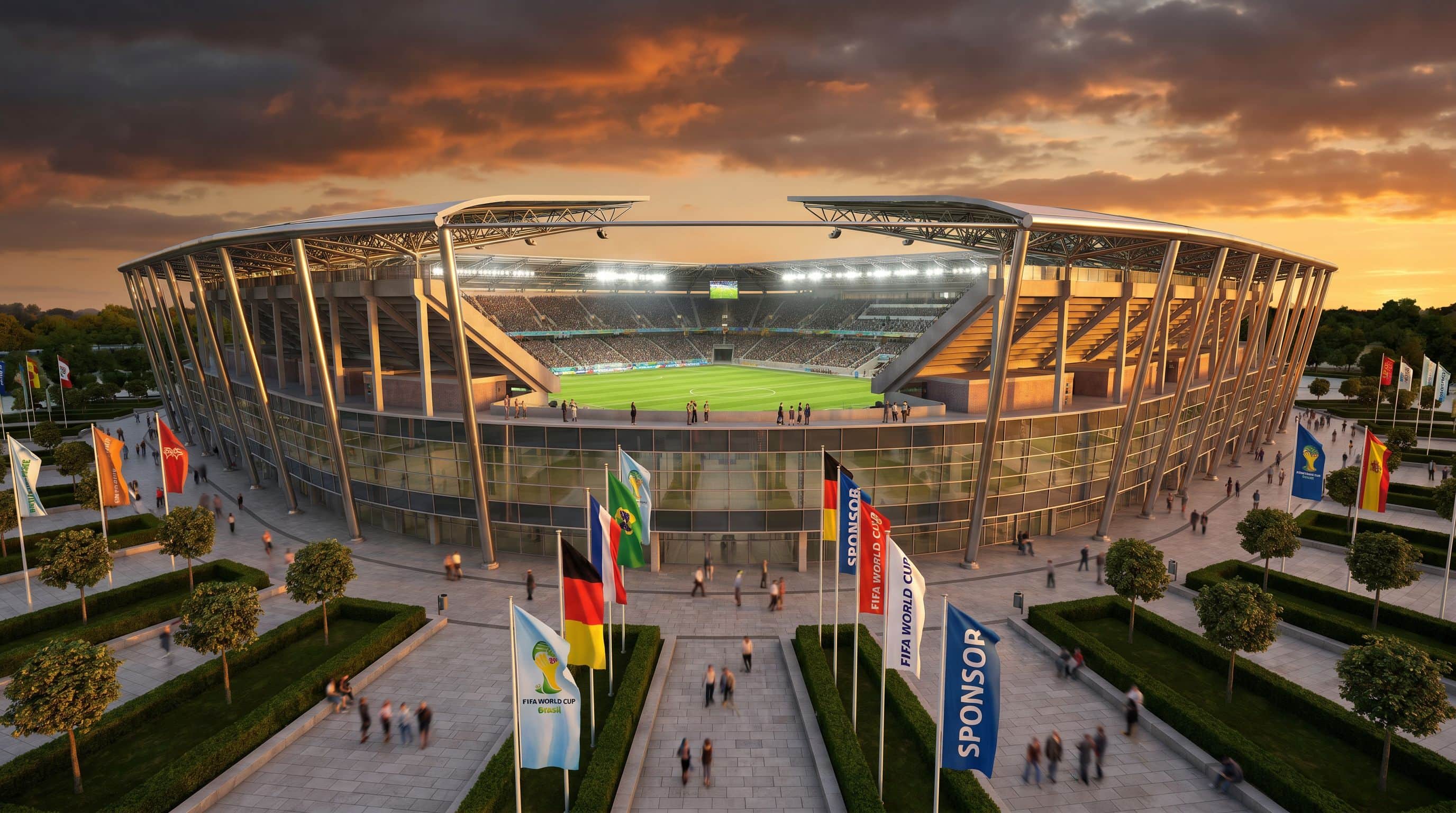
Aramco Locks Down AFC Asian Cup Sponsorship — and Stadium Naming Rights That Change Everything
Aramco has officially signed on as an Official Global Supporter of the AFC Asian Cup Saudi Arabia 2027, a deal that includes naming rights to the new Al Khobar stadium — marking the first time in the tournament's 68-year history that venue naming rights have been bundled into the commercial structure of Asia's flagship football championship. Inside World Football reported the announcement this week, and while the AFC didn't disclose financial terms, the combination of global supporter status and stadium naming rights signals a deal that likely sits well into eight-figure territory when you factor in the full activation timeline.
This isn't just another logo on a LED board. This is the AFC finally cracking open a revenue model that UEFA and CONCACAF properties have been exploiting for years — and doing it with a partner that has every strategic reason to push the template further than anyone expects.
Why This Matters: The AFC Just Jumped Two Generations of Commercial Evolution in One Deal
Let's be direct about what happened here. The Asian Football Confederation has historically been conservative in how it packages commercial rights. Title sponsorships, yes. Broadcast deals, of course. But venue naming rights within a continental tournament? That's a structural innovation for this property, and the implications ripple far beyond one stadium in Al Khobar.
Consider the precedent chain:
- UEFA has long allowed tournament venues to retain their existing naming rights (Allianz Arena, Veltins-Arena) during Euros and Champions League matches, though it typically strips them during the tournament itself for clean venue branding. The AFC is doing something different — it's creating naming rights specifically for the tournament and selling them as part of an integrated package.
- FIFA experimented with varying degrees of venue commercialization at World Cups, but has generally kept stadium naming separate from the tournament's tiered sponsor structure.
- MLS and the NFL have normalized naming rights as standalone assets, but those are league-owned or franchise-owned venues with 10-20 year deals. Attaching naming rights to a tournament venue for what is presumably a shorter-term arrangement is a genuinely different commercial product.
The AFC didn't just adopt a Western model. They hybridized it. And that hybrid is going to force every other confederation — and every brand evaluating Asian football properties — to recalibrate what's possible.
The Aramco Strategic Logic: This Isn't About Selling Oil
There's a lazy analysis floating around that frames every Saudi sponsorship as "sportswashing." We're not going to waste your time with that debate. What we are going to do is look at Aramco's actual sponsorship portfolio and explain why this particular deal makes ruthless strategic sense from a brand architecture perspective.
Aramco's recent sponsorship footprint includes:
- Formula 1 — title sponsor of the Saudi Arabian Grand Prix and a global F1 partner
- FIFA — a major partner through 2027 (including the expanded Club World Cup and the 2026 World Cup)
- PGA Tour / LIV Golf — entangled through the PIF connection
- AFC Asian Cup 2027 — the new addition
Notice the pattern? Aramco isn't just buying awareness. It's building what we internally call "Infrastructure Brand Positioning" — the strategy of associating a corporate brand not with a single team or athlete, but with the structural fabric of global sports. The naming rights component at Al Khobar is critical because it physically embeds the Aramco brand into the built environment of Saudi Arabia's sporting ambition.
This is a company that's IPO'd, that's diversifying into chemicals and hydrogen, and that needs its brand to signal modernity and permanence to institutional investors, sovereign wealth partners, and the global business community. A stadium with your name on it during a tournament watched by 2+ billion potential viewers across Asia? That's not a media buy. That's a geopolitical brand asset.
Key insight: When you see a state-adjacent enterprise buying naming rights to a tournament venue in its own country, you're not looking at a sponsorship. You're looking at nation-brand infrastructure. The ROI model is fundamentally different from anything a CPG brand would run.
The Bundled Rights Model: A Framework We're Calling "The Sponsorship Gravity Stack"
The Aramco-AFC deal is interesting not just for what was sold, but for how it was structured. Combining global supporter status with stadium naming rights creates what we've started calling The Sponsorship Gravity Stack — a deal architecture where multiple rights layers are bundled to create gravitational pull that makes the partnership harder to replicate, harder to compete with, and harder to walk away from.
Here's the framework:
The Sponsorship Gravity Stack (3 Layers)
-
Visibility Layer (Global Supporter Status) — broadcast exposure, digital assets, tournament branding, hospitality access. This is the traditional tier most brands are buying when they sign a confederation deal. It's measurable, it's commoditized, and frankly, it's the layer where ROI arguments get made to CFOs.
-
Permanence Layer (Stadium Naming Rights) — physical infrastructure branding that outlasts the tournament window. Even if the naming rights are technically limited to the tournament period, the Al Khobar stadium will be photographed, discussed, and referenced with the Aramco name attached for years. This layer converts a time-limited sponsorship into something that behaves more like a long-term asset.
-
Ecosystem Layer (Host Country Alignment) — when the sponsor is also deeply embedded in the host nation's economy, you get a third gravitational force. Aramco isn't just sponsoring an event in Saudi Arabia; Aramco is Saudi Arabia's economic backbone. This creates a level of integration between sponsor, host, and property that no outside competitor can match.
When all three layers stack, you get a partnership with extreme defensibility. Try to imagine another energy company outbidding Aramco for this particular package. You can't. The gravity is too strong.
This framework matters for brands evaluating any major property, not just the Asian Cup. Ask yourself: are you buying a single layer, or are you stacking? Because in our experience, single-layer deals get renegotiated every cycle. Stacked deals become embedded partnerships that compound in value.
For sponsorship professionals trying to build these kinds of multi-layered proposals — especially when you're pitching to a property and need to show how bundled rights create more value than the sum of their parts — this is exactly where tools like SponsorFlo's AI-powered proposal generation become genuinely useful. Building a Gravity Stack proposal manually takes weeks. Having AI model different bundling scenarios and their projected value lets you move faster and present more sophisticated options to the property.
What the AFC Is Really Signaling to the Market
Let's read between the lines of this announcement. The AFC isn't just celebrating a new sponsor. They're running a market-signaling operation ahead of what will be one of the most commercially significant Asian Cups ever staged.
Saudi Arabia 2027 will be the first Asian Cup held in the Kingdom, and it arrives at a moment when Saudi sports infrastructure is being built at a pace that rivals — maybe exceeds — Qatar's pre-World Cup construction boom. New stadiums in Riyadh, Jeddah, Al Khobar, and elsewhere are being designed not just for the tournament, but as permanent commercial venues.
By announcing the Aramco deal with the naming rights component now — more than a year before the tournament — the AFC is sending a specific message to potential sponsors: "We're open for business on deal structures you haven't seen from us before."
Translation for brands and agencies: the AFC is likely willing to negotiate integrated packages that combine:
- Tournament sponsorship tiers
- Venue naming rights (possibly across multiple stadiums)
- Digital content partnerships
- Regional activation exclusivities
- Data and fan engagement rights
If you're a technology company, an automotive brand, or a financial services firm with ambitions in the Asian market — and you're not already in conversations with the AFC's commercial team — you're behind.
The Valuation Question: What Are Tournament Naming Rights Actually Worth?
Since the AFC didn't disclose terms, let's try to triangulate a reasonable valuation range for what Aramco might be paying.
Comparable data points:
- Naming rights for major football stadiums in the Middle East have ranged from $5M–$15M annually for premium venues (Etihad Arena, various Gulf state facilities)
- Global supporter-level deals for continental championships typically run $10M–$30M per tournament cycle, depending on the property's broadcast footprint
- The AFC Asian Cup reaches 24 participating nations and an estimated cumulative television audience that exceeded 3 billion for the 2023 edition in Qatar
- Aramco's F1 deal is reportedly worth approximately $75M annually, though that includes multiple race title sponsorships
Our best estimate: the combined Global Supporter + Naming Rights package is likely in the range of $25M–$50M when you factor in the full activation period, assuming a 2-3 year term that covers the build-up, tournament, and post-event window. That's a significant jump from what the AFC has historically commanded for a single partner, and it validates the bundled approach.
Here's what's interesting from a market-making perspective: if the AFC can demonstrate that bundled packages command a 40-60% premium over traditional tier-based deals (which our back-of-napkin math suggests they might), every future AFC commercial negotiation will use this deal as the anchor.
This is a classic example of what we call "The Anchor Deal Effect" — when a single landmark partnership resets pricing expectations for an entire property portfolio. We saw it when Chevrolet signed with Manchester United for $80M/year in 2014 (a deal widely seen as above market at the time), which subsequently pulled up shirt sponsorship valuations across the Premier League. The Aramco-AFC deal could do the same for Asian football properties.
For Brands: A Decision Framework for Evaluating Asian Football Opportunities
If you're a brand considering sponsorship opportunities in Asian football — whether it's the AFC Asian Cup, the AFC Champions League Elite, or national team partnerships — the Aramco deal creates both opportunity and urgency. Here's a framework we've developed for evaluating these properties, which we're calling The Continental Property Readiness Score (CPRS).
Rate each factor on a 1-5 scale:
| Factor | What It Measures | Aramco-AFC Score |
|---|---|---|
| Broadcast Reach | Cumulative audience across target markets | 5 |
| Commercial Maturity | Sophistication of rights packaging and activation support | 3 (improving rapidly) |
| Host Market Alignment | Does the tournament location match your strategic markets? | 5 for Gulf/Asia-focused brands |
| Category Exclusivity Value | How much is it worth to lock out competitors? | 4 |
| Digital Ecosystem Access | Quality of fan data, social media integration, content rights | 3 |
| Infrastructure Permanence | Will venues and brand associations persist post-tournament? | 4 |
| Competitive Scarcity | How few opportunities like this exist? | 5 |
CPRS Total: 29/35 — That's a strong score, and it explains why Aramco moved early.
For comparison, a typical European club sponsorship might score higher on Commercial Maturity and Digital Ecosystem Access but lower on Competitive Scarcity and Host Market Alignment for brands targeting Asian consumers.
The point isn't that one is better than the other. The point is that most brands don't have a systematic way to compare fundamentally different sponsorship opportunities across geographies and property types. They end up making decisions based on relationship networks and gut feel, which is how you end up overpaying for properties that look impressive but underdeliver on your actual strategic objectives.
This is another area where we've invested heavily at SponsorFlo. Our partner CRM and deal evaluation tools are specifically designed to help sponsorship teams compare properties across dimensions like these — not just media value, but strategic fit, activation potential, and portfolio balance. When you're evaluating whether to pursue an AFC opportunity versus a domestic league deal versus an esports partnership, you need a common analytical language. Spreadsheets won't cut it.
The Naming Rights Precedent: Who Follows Aramco?
Let's make some predictions about where the naming rights model goes from here.
Prediction 1: At least two more AFC Asian Cup 2027 venues will secure naming rights partners by Q1 2027. The Aramco deal proves the model works. The AFC will almost certainly offer similar packages for the Riyadh and Jeddah venues, likely targeting technology companies (a natural fit would be a Saudi-connected tech firm like stc or a global player like SAP) and automotive brands (Hyundai, which already has AFC ties, seems like an obvious candidate).
Prediction 2: FIFA will incorporate venue naming rights more aggressively into the 2030 and 2034 World Cup commercial structures. The 2034 World Cup is in Saudi Arabia. If the AFC successfully bundles naming rights for the Asian Cup, FIFA — which has historically been more conservative about venue commercialization during tournaments — will face pressure to offer similar packages. The revenue opportunity is simply too large to ignore.
Prediction 3: We'll see a "naming rights arms race" in Asian football within 18 months. The AFC Champions League Elite, the expanded Club World Cup's Asian qualifying pathway, and domestic leagues across the Gulf and Southeast Asia will all start packaging venue naming rights more aggressively. Brands that establish positions now will have first-mover advantages; those that wait will pay significantly more.
Prediction 4: The definition of "naming rights" will expand beyond physical stadiums. Expect to see digital naming rights — branded virtual stadiums in broadcast overlays, named content hubs within tournament apps, and named data experiences for fans. The infrastructure is physical today, but the most valuable naming rights in five years will be digital.
The Uncomfortable Question: Does Host-Country Sponsor Dominance Limit the Property's Commercial Ceiling?
Here's a question that nobody in the AFC's commercial department wants to hear, but that every outside brand is quietly asking: if the anchor sponsor of the tournament is also the economic engine of the host country, does that create a gravitational field so strong that it actually discourages other sponsors from entering?
There's a real risk here. When Aramco holds both global supporter status and the most prominent venue naming rights, other brands might perceive the commercial space as "owned" by Saudi interests. That perception — fair or not — could suppress competitive tension in the sponsorship marketplace and reduce the total commercial revenue the AFC can generate.
We've seen this dynamic play out in other contexts. When a single sponsor dominates a property's commercial ecosystem (think Emirates and Arsenal, or Red Bull and its racing empire), the property can become synonymous with that one brand to the point where other sponsors feel like secondary players. The FIFA World Cup has historically managed this well by maintaining genuine competitive tension between sponsors across categories. The AFC will need to be equally disciplined.
The solution? Aggressive category diversification. The AFC needs to ensure that the remaining sponsorship tiers are filled by brands from genuinely different industries and geographies. A tournament where the top sponsors are all Gulf-based energy and construction companies would be commercially suboptimal. What the AFC should be chasing: Japanese automotive, Korean electronics, Indian fintech, Chinese technology, European luxury goods. Geographic and category diversity in the sponsor roster is what creates the perception of a truly global property.
What This Means for Mid-Market Brands and the Democratization of Deal Intelligence
One more angle that's worth exploring: what does the growing sophistication of AFC commercial packages mean for brands that aren't in Aramco's weight class?
The truth is that deals like this — bundled, multi-layered, strategically complex — used to be the exclusive domain of brands with $50M+ sponsorship budgets and dedicated agencies negotiating on their behalf. The mid-market brand looking to activate at a regional level within the Asian Cup couldn't even get a meeting, let alone understand how to structure a competitive proposal.
That's changing, and it's changing because of better tooling and data access. When a mid-market brand can use AI-driven platforms to analyze comparable deal structures, model different rights combinations, and generate professional proposals that speak the property's commercial language, the playing field shifts. Not completely — Aramco's deal is still a function of capital and geopolitical alignment that no tool can replicate — but meaningfully.
At SponsorFlo, this is core to what we're building. Our AI proposal and agreement tools are designed so that a sponsorship director at a $500M revenue company can approach the AFC (or any property) with the same analytical sophistication that Aramco's team brings to the table. You might not be buying the stadium naming rights, but you might be structuring a regional activation package with digital content rights and hospitality access that delivers exceptional ROI for your specific markets. The intelligence gap between mega-sponsors and mid-market brands is the gap we're actively closing.
Looking Ahead: The 2027 Asian Cup as a Commercial Watershed
The Aramco AFC Asian Cup sponsorship and its accompanying stadium naming rights in Asia aren't just a single deal. They're the opening move in what will likely be the most commercially ambitious continental football tournament ever staged outside of Europe.
Saudi Arabia is building sports infrastructure at a scale and pace that demands new commercial models. The AFC, to its credit, appears willing to innovate on rights packaging rather than simply selling the same tier-based structures that have defined continental tournaments for decades. And brands — from state-backed energy giants to mid-market challengers — are going to have to develop far more sophisticated evaluation and negotiation capabilities to compete in this new environment.
Our specific prediction: by the time the AFC Asian Cup 2027 kicks off, the tournament's total commercial revenue will exceed $500M, roughly double what the 2023 edition generated. The naming rights model will be a significant contributor, but the real driver will be the cascade effect — once brands see the Aramco template, they'll demand similar integrated packages, and the AFC will accommodate them because the new stadiums create inventory that simply didn't exist before.
For sponsorship professionals, the takeaway is clear: Asian football properties are no longer the "emerging" opportunity your agency pitches as a diversification play. They're becoming primary assets that demand primary attention, primary budgets, and primary analytical rigor.
If you're building your sponsorship strategy for 2027 and beyond, the tools and frameworks you use to evaluate, negotiate, and manage these partnerships matter more than ever. That's what we're focused on at sponsorflo.ai — giving every sponsorship team the intelligence to compete at the level these properties now demand.