On this page
What is sports sponsorship?
Sports sponsorship is a marketing partnership in which a brand provides funding or resources to a team, league, event, athlete, or venue in exchange for marketing rights and brand association. Unlike a standard advertisement, a sponsorship connects the brand to the emotion and loyalty fans already feel toward the property.
For example, a regional bank that sponsors a minor-league baseball team can place its logo on the outfield wall, host a branded between-innings promotion, and welcome clients into a hospitality suite, all during a single game. That combination of visibility, hospitality, and community connection is what makes sports sponsorship valuable for brands of every size.
What are the main types of sports sponsorships?
The six main types of sports sponsorship are team, venue, event, athlete, broadcast, and digital and social sponsorships. Each has distinct assets and value, which helps you decide which opportunities to sell and how to price them.
| Type | What it is | Example assets |
|---|---|---|
| Team sponsorships | A brand partners with a professional or amateur sports team in exchange for jersey patches, naming rights, official partner designations, and hospitality access. | Jersey patches, official team partner, training facility naming, team travel partner |
| Venue sponsorships | Stadium naming rights, in-venue signage, concourse activations, and premium seating experiences that put a brand in front of every attendee. | Naming rights, LED ribbon boards, concourse branding, suite hospitality |
| Event sponsorships | Title or presenting sponsorship of tournaments, championships, and special events, giving brands top billing across marketing and broadcast. | Title sponsor, presenting sponsor, category sponsor, official supplier |
| Athlete sponsorships | Individual athlete endorsements, appearances, and brand ambassadorships that connect a sponsor to a specific personality and fan base. | Endorsement deals, appearance fees, social media posts, product use |
| Broadcast sponsorships | Pre-game, halftime, and post-game show sponsorships across TV, radio, and streaming platforms that reach audiences beyond the venue. | Pre-game show, halftime sponsor, replay sponsor, streaming overlay |
| Digital and social sponsorships | Content series, social media activations, and digital-first partnerships designed for younger, mobile-first audiences. | Content series, social takeovers, fantasy integration, app sponsorship |
How do you value sports sponsorship assets?
Most sports properties value sponsorship assets with one or more of four methods: impressions-based valuation, comparable deals analysis, cost-plus pricing, and ROI-based pricing. Accurate valuation is the foundation of fair pricing and productive negotiations.
Impressions-based valuation
Calculate value based on total impressions across all assets, including signage, broadcast, and digital, using CPM benchmarks for your market.
Value = Total Impressions × CPM ÷ 1,000Best for: Established properties with reliable audience data.Comparable deals analysis
Research similar sponsorship deals in your sport and market, then adjust for audience size, demographics, and asset mix.
Value = Comparable Deal × (Your Audience ÷ Comp Audience) × Quality AdjustmentBest for: Properties entering new categories or markets.Cost-plus pricing
Add up the actual cost to deliver every asset, then apply a margin that reflects the marketing value the sponsor receives.
Value = (Hard Costs + Opportunity Cost) × (1 + Margin)Best for: Properties with high activation costs.ROI-based pricing
Price the package based on the projected business return the sponsor will earn from the partnership.
Value = Projected Sponsor Revenue × Share of ValueBest for: Performance-based or outcome-focused deals.
How do you build sports sponsorship packages?
Build sports sponsorship packages in tiers so sponsors can choose the investment level that matches their budget while you keep a clear upsell path. Below is a common four-tier structure, with typical investment ranges to adjust for your market.
Title / presenting
$1M+- Exclusive category rights
- Naming integration, such as “Title Sponsor Arena”
- Primary logo placement on all materials
- First right of refusal on renewals
- Executive hospitality suite
- Field or court access
- Full broadcast integration
- Extensive digital and social presence
Gold / premier
$250K–$1M- Category exclusivity
- Secondary logo placement
- In-venue signage package
- Broadcast mentions
- Social media content series
- Premium hospitality package
- Meet-and-greet opportunities
- Event activation rights
Silver / official
$50K–$250K- Official partner designation
- Select signage placement
- Digital advertising package
- Social media recognition
- Hospitality tickets
- Promotional rights
- Newsletter features
Bronze / supporting
$10K–$50K- Supporting sponsor recognition
- Website logo placement
- Social media mentions
- Event tickets
- Promotional use rights
- Email recognition
How do you find sponsors for a sports team?
The best sponsor prospects are brands that already want to reach your audience. Strategic prospecting identifies those brands so you can build a pipeline of qualified leads instead of cold-calling hundreds of companies.
Industry mapping
Identify companies in product categories that match your audience demographics and lifestyle interests.
- Research industry leaders in each category.
- Note the brands that already sponsor your competitors.
- Monitor category spending trends.
- Identify emerging brands seeking awareness.
Local market focus
Target businesses with headquarters or major operations in your geographic market, because local relevance drives sponsor interest.
- Map local Fortune 500 and mid-market companies.
- Research regional restaurant and retail chains.
- Connect with chambers of commerce.
- Review local business publications.
Fan affinity analysis
Survey fans to learn which brands they already buy from and prefer, then use that data to pitch relevant sponsors.
- Run fan surveys on brand preference.
- Analyze social media conversations.
- Explore purchase-data partnerships.
- Segment fans by lifestyle and spending.
Warm introduction networks
Leverage your board members, existing sponsors, and season-ticket holders to get introductions to decision-makers at target brands.
- Ask board members for connections.
- Run a sponsor referral program.
- Reach business owners among season-ticket holders.
- Tap alumni and booster networks.
How do you negotiate a sports sponsorship contract?
Good negotiation protects your rate card while making the sponsor feel they are getting genuine value. These strategies help you close stronger deals and build partnerships that last beyond a single season.
Know your walk-away point
Set a minimum acceptable deal value before negotiations begin, and hold to it so you protect your rate card for future deals.Lead with value, not price
Focus the conversation on the sponsor's objectives and how your assets deliver results before discussing investment levels.Create package options
Offer three to four package options at different price points so the sponsor can choose the level that fits their budget and goals.Bundle strategically
Combine high-visibility and supporting assets into a single package to create more compelling value at a premium price.Build in performance bonuses
Structure deals with a base fee plus performance bonuses tied to specific outcomes like attendance, ratings, or social engagement.Offer multi-year incentives
Provide added value or a modest discount for multi-year commitments, which locks in revenue and shortens future sales cycles.
How do you activate and fulfill a sports sponsorship?
Signing the deal is only the beginning. Sponsorship success depends on activating every deliverable on time before, during, and after the event, and documenting the results so sponsors see the value they paid for.
Pre-event activation
- Announce the partnership with a joint press release
- Launch a co-branded content series
- Integrate the sponsor into promotional materials
- Activate a social media campaign
- Set up tracking and measurement tools
In-game and event activation
- Signage and LED board displays
- PA announcements and in-broadcast mentions
- Experiential activations on the concourse
- Hospitality and VIP experiences
- Product sampling and demonstrations
Post-event follow-up
- Deliver a recap report with proof of performance
- Share a media value analysis
- Provide photo and video assets the sponsor can reuse
- Schedule a renewal conversation while results are fresh
- Gather sponsor feedback to improve the next season
How do you measure sports sponsorship ROI?
Sponsors renew when they can see clear return on investment. The strongest measurement programs combine media value, brand metrics, business outcomes, and engagement metrics, and establish baselines before the sponsorship begins.
Media value
- Broadcast exposure value
- Digital impression value
- Social media earned value
- PR and news coverage value
Brand metrics
- Brand awareness lift
- Brand favorability change
- Purchase intent increase
- Net Promoter Score impact
Business outcomes
- Lead generation
- Sales attribution
- Customer acquisition cost
- Customer lifetime value
Engagement metrics
- Event attendance
- Activation participation
- Social engagement rate
- Content consumption
How do you manage sports sponsorships?
Selling sponsorships is half the job. The other half is managing every deal, deliverable, and payment so nothing falls through the cracks and sponsors see proof of what they paid for.
SponsorFlo is sponsorship management software built for teams, leagues, venues, and events that sell sponsorships. It brings your pipeline, proposals, agreements, deliverables, and payments into a single platform so your staff does not have to juggle spreadsheets and email threads.
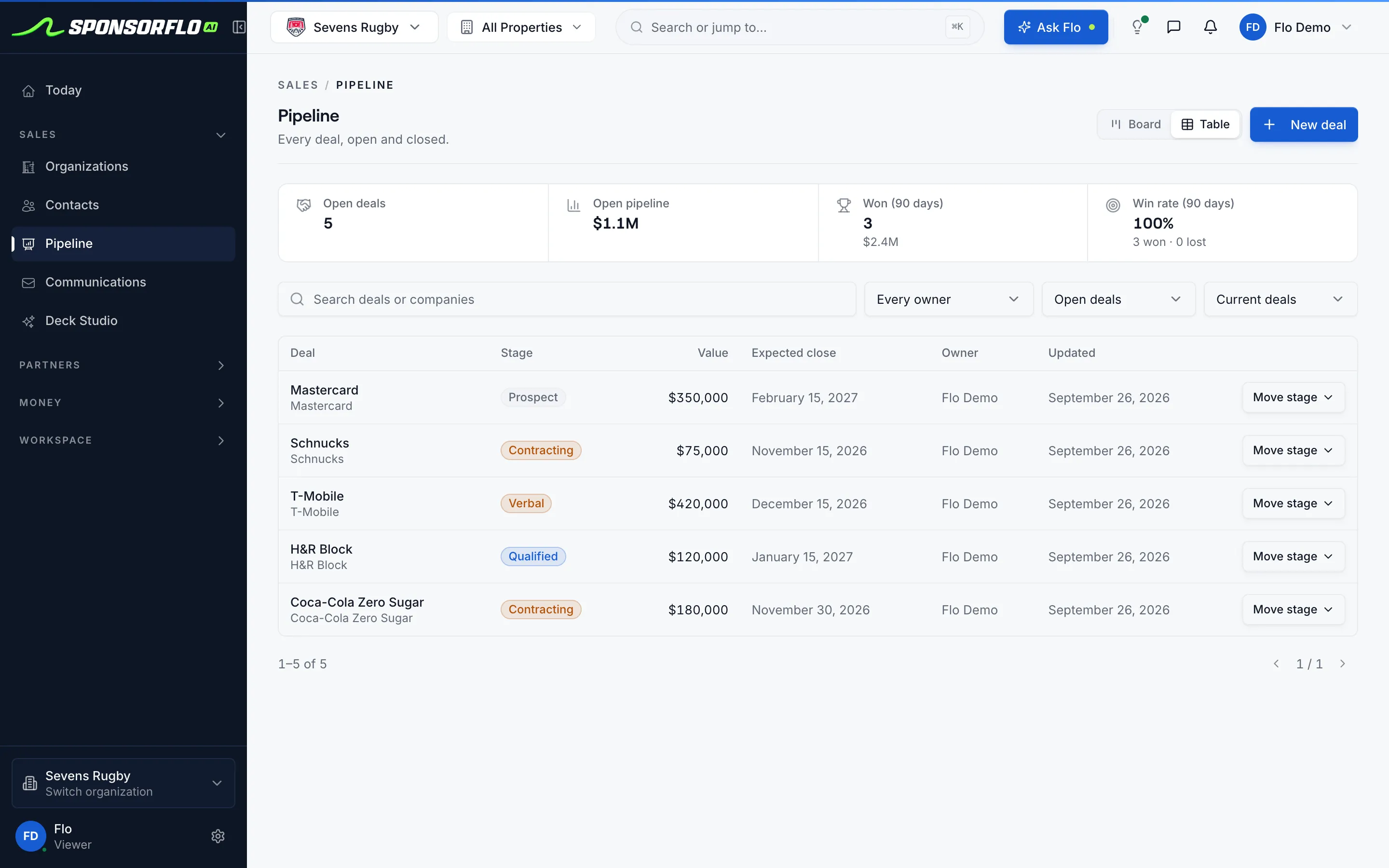
- Track every deal in a pipeline with stage, value, and expected close date.
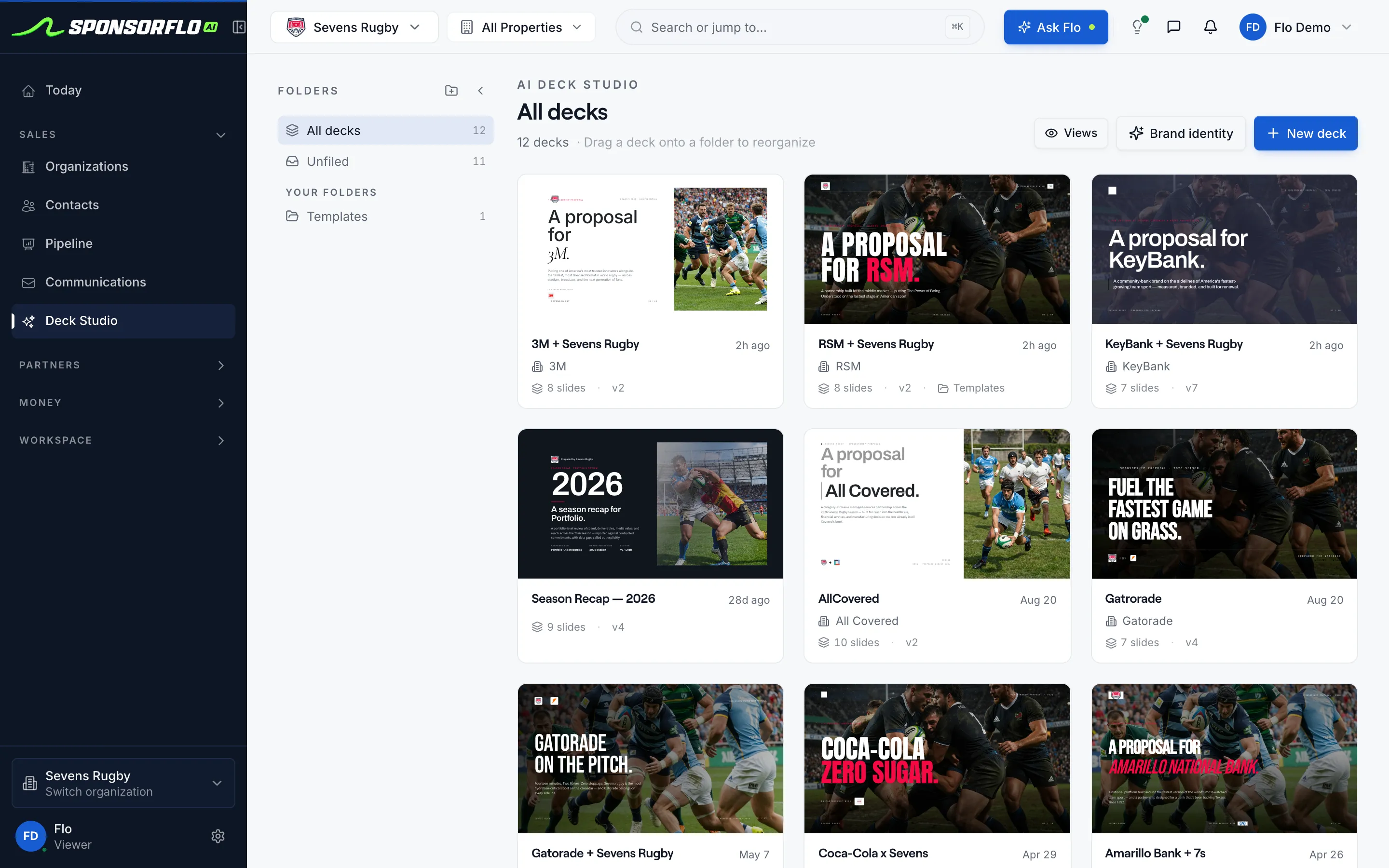
- Build branded proposals with AI-powered Deck Studio and send them as tracked links.
- Manage deliverables with status, due dates, and proof-of-performance attachments.
- Upload contracts and let AI extract terms and deliverables automatically.
- Analyze sponsor logo exposure in YouTube, Instagram, TikTok, or X videos with Video ROI.
- Give sponsors a partner portal where they can view their deliverables and proof.
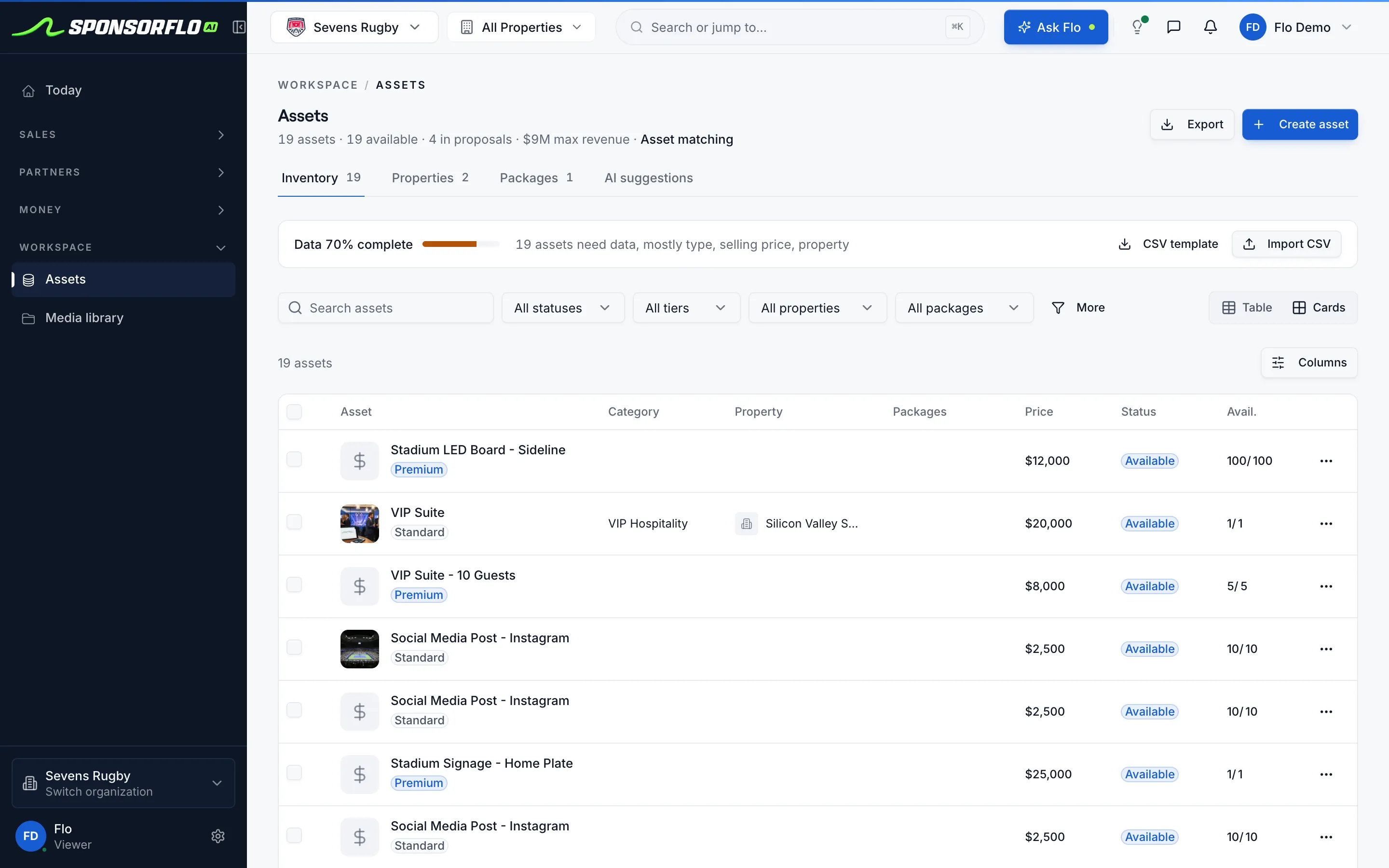
- Catalog your inventory of sellable assets with category, tier, price, and availability.
- View pipeline value, conversion rate, and average proposal value in analytics dashboards.
Questions
- How much should I charge for sports sponsorship?
- Sponsorship pricing depends on your audience size, demographics, asset mix, and market. A common starting point is impressions-based valuation: calculate total impressions across all assets and apply a CPM rate that reflects comparable media in your market. Then factor in category exclusivity, activation value, and comparable deals in your sport.
- What makes a sports sponsorship successful?
- Successful sponsorships start with clear objectives shared by both the property and the sponsor. They also require authentic brand-property fit, activation investment that roughly matches the rights fee, a measurement framework agreed on before the season starts, and genuine long-term commitment from both sides.
- How do I find sponsors for my sports team?
- Start with companies that already have a relationship with your organization, such as suppliers, vendors, and businesses owned by season-ticket holders. Then expand to brands targeting your demographic by researching competitor sponsors, leveraging board connections, and running systematic outreach campaigns focused on the categories that match your fan base.
- What is the typical sponsorship contract length?
- Most sports sponsorships run one to five years. Larger deals like naming rights and major partnerships often span 10 to 20 years. Longer terms give both parties stability and better return on investment, but they should include flexibility clauses so the agreement can adapt to changing business conditions.
- How do I measure sports sponsorship ROI?
- Combine media value metrics such as impressions and broadcast exposure, brand metrics like awareness and favorability surveys, and business outcomes including leads and sales attribution. The strongest programs establish baseline metrics before the sponsorship begins and track changes over each season or event cycle.