
Built for sponsorships
How SponsorFlo’s AI sponsorship management tools work.
SponsorFlo’s AI runs on Anthropic’s Claude and OpenAI models, inside workflows, harnesses and checks SponsorFlo built for sponsorship decks, contracts, deliverables and renewals. Every deck edit is checked before you see it, and nothing goes to a sponsor without your approval.
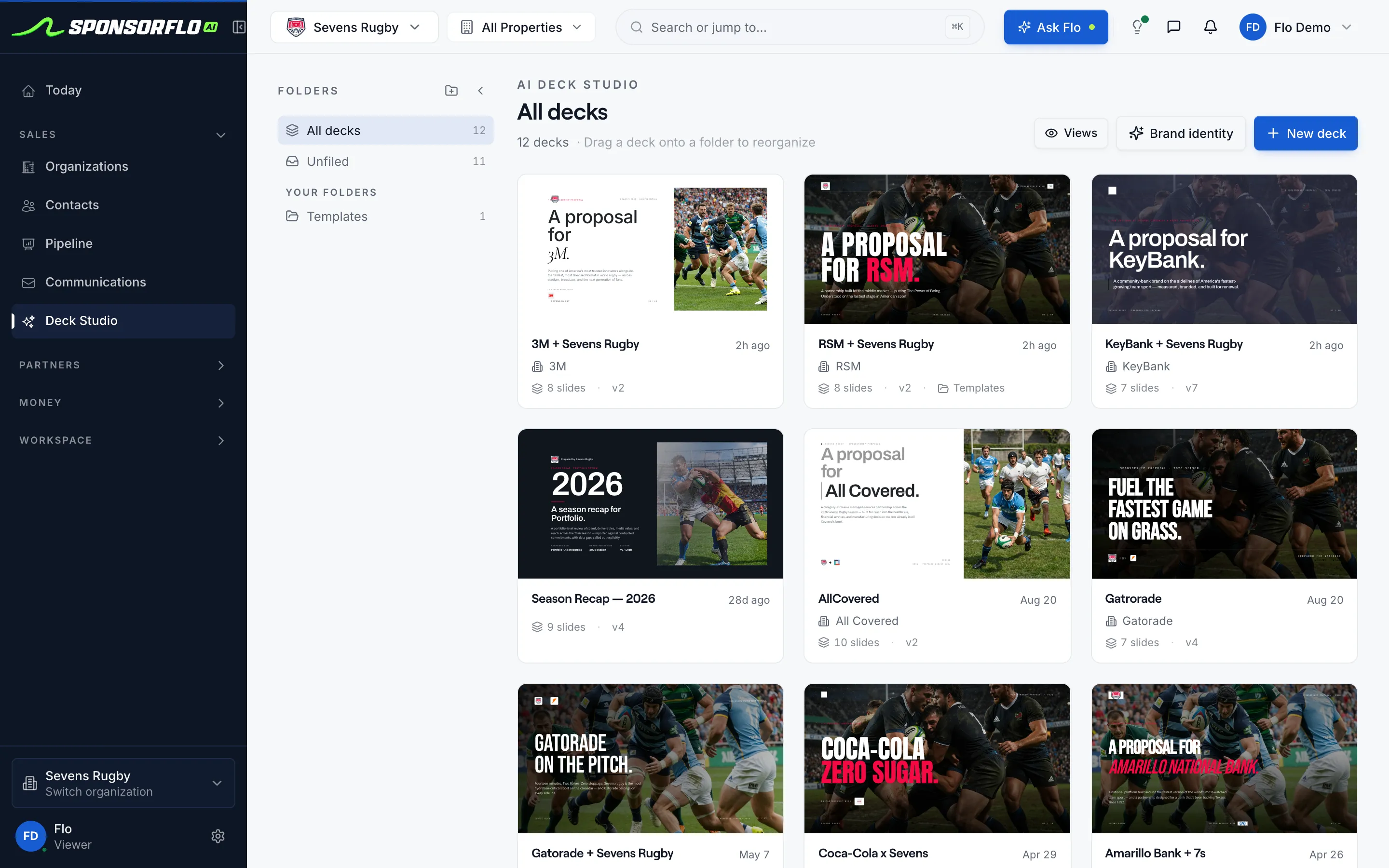
Screens are from Sevens Rugby, our read-only demo workspace.
What are AI sponsorship management tools?
AI sponsorship management tools are software that uses AI to do the slow parts of selling and delivering a sponsorship: building the pitch deck, reading the contract, drafting the follow-up, and proving what ran. SponsorFlo is sponsorship management software whose AI runs on frontier models from Anthropic and OpenAI, inside workflows, harnesses and evaluation suites SponsorFlo built for sponsorship work: pitching, contracts, deliverables and renewals. SponsorFlo does not train its own model today. It decides which model does each job, what the model is allowed to change, how its work is checked, and what waits for your approval.
- Deck Studio
writes and edits a branded sponsorship deck from your inventory.
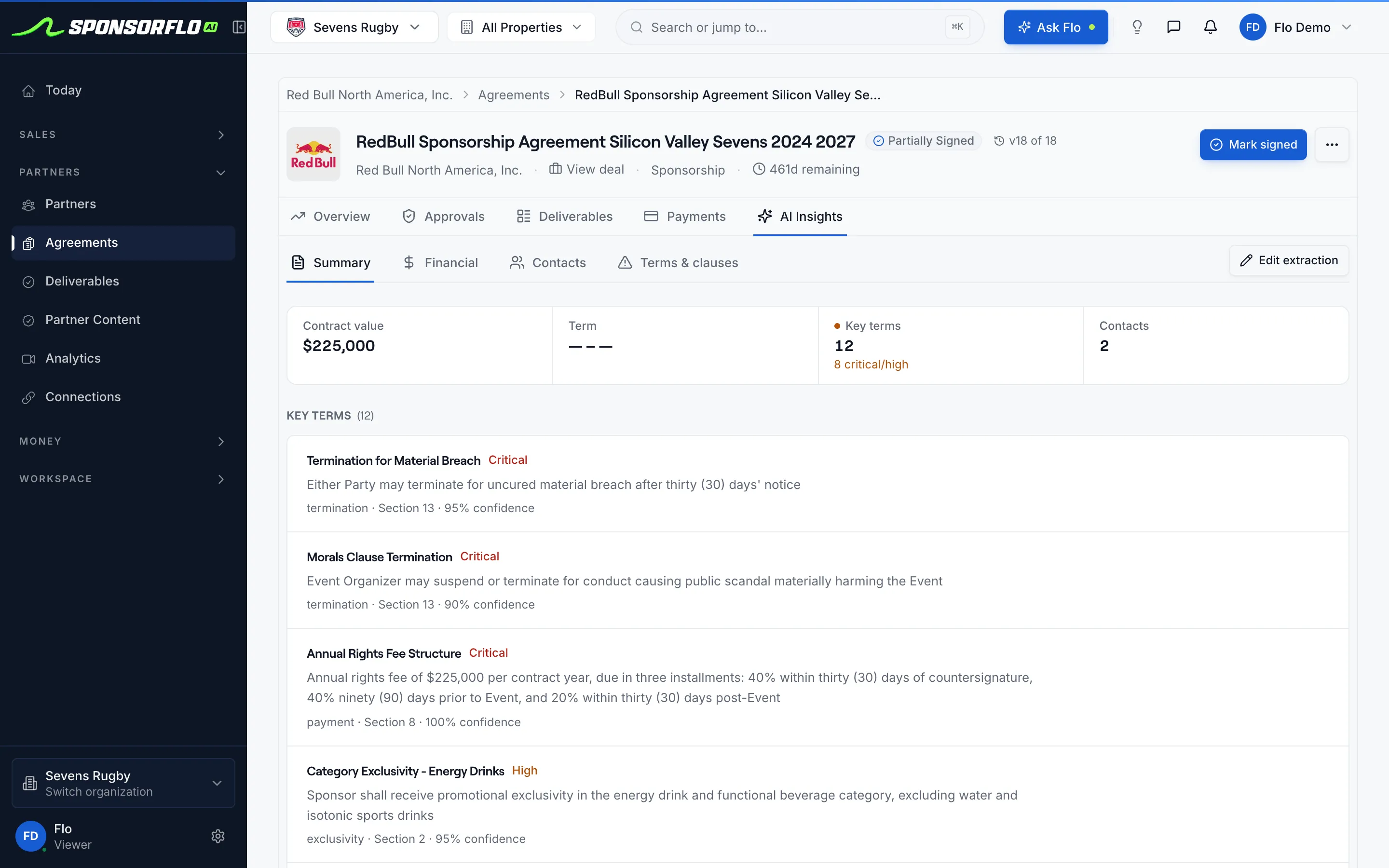
- Contract extraction
turns a signed agreement into deliverables and a payment schedule.
- Email drafts
writes the follow-up from the deal history.
- Video ROI
measures sponsor logo time on screen in a clip.
What AI does SponsorFlo run on?
SponsorFlo runs on Anthropic’s Claude models, through Amazon Bedrock in SponsorFlo’s own AWS account and through Anthropic’s API, and builds on OpenAI for search, voice and a few drafting jobs. Each job goes to the smallest model that does it well, so a simple task stays fast and the hard ones get the most capable model.
Claude on Amazon Bedrock
SponsorFlo runs Anthropic’s Claude models on Amazon Bedrock in its own AWS account, in US regions, for Flo, contract extraction, email drafts and deliverable analysis.
Claude through Anthropic’s API
Deck Studio, where SponsorFlo writes and edits sponsorship decks, calls Anthropic’s most capable Claude models through Anthropic’s API.
OpenAI
SponsorFlo builds on OpenAI for search embeddings, voice transcription in Deck Studio, and a few document and drafting jobs, such as reviewing an agreement draft and suggesting email replies.
Specialist models
AI images and logo mockups, video brand detection and voice each use a model built for that job, and each receives only the files and text that feature needs.
The right model for each job
A contract and a conversation title do not need the same model. SponsorFlo routes each job by what it asks of the model.
- Sorting and tagging
- A small, fast Claude model
- Titling a Flo conversation, tagging the photos in your file library, and pulling the key facts out of a document you upload.
- Reading and drafting
- A mid-size Claude model
- Pulling the fee, term and deliverables out of a signed contract, drafting a follow-up email, and reviewing a rendered slide.
- Planning and design
- Anthropic’s largest Claude models
- Flo answering a question across your deals, and Deck Studio writing a new deck or editing one from a chat message.
How does SponsorFlo keep a sponsorship AI agent on task?
SponsorFlo keeps its sponsorship AI agent on task with harnesses built for sponsorship work: the model can only act through typed tools, big changes wait for you, and every deck edit is rendered and checked before you see it. A frontier model on its own writes a good paragraph; the harness is what makes it safe to let it touch a $40,000 jersey patch proposal.
Typed tools
Flo and Deck Studio act only through tools with typed input schemas, and every change Flo proposes is checked against its schema before it reaches your queue and again when you accept it.
Impact tiers
In Deck Studio chat, an edit to the slides you named is applied, a small fix next door is applied and named so you can undo it, and a bigger change, such as a new color scheme, a reordered deck or any price, waits for your Yes.
Render and verify
After a Deck Studio edit, SponsorFlo renders the slides that changed, measures them for problems like overflowing headlines, clipped photos and low contrast, and shows the model the result so it can fix its own work before you see it.
Visual review
A separate model looks at images of the finished slides for problems a buyer would notice, such as text running off the slide, a logo cropped out of a photo, or words that are hard to read over an image.
Repair budgets and cost caps
Each turn gets a fixed number of repair attempts and a cost ceiling, so a hard request ends with a clear answer instead of an open-ended loop.
Hard limits
Deck Studio refuses a proposal that invents facts, pulls in outside images or breaks your brand kit, before anything is saved.
How does SponsorFlo check the AI’s work?
SponsorFlo checks the AI’s work by measuring the result, not by trusting the model’s own report. Inside the product, a Deck Studio edit is rendered, measured and reviewed before it reaches you. SponsorFlo tests changes to Deck Studio’s AI against replay suites built from real sponsorship deck requests and against layout cases scored by measuring the rendered slides, not by asking the model whether it did well.
Take a request like “make the hospitality slide punchier.” The check renders that slide the way the export will, measures whether the new headline still fits, and sends the model a picture of the result. If the headline wraps onto a photo, the model fixes it in the same turn, and you see one finished slide.
You can see the same kind of check from the outside on our sample inputs and outputs, which show what each AI feature returns and where to check its work.
What does SponsorFlo’s AI do without asking?
SponsorFlo’s AI drafts and prepares, and a person decides. Flo never sends an email or a deck, signs an agreement, or changes a price on its own. Outbound messages and anything that cannot be undone always wait in the Flo queue for a person to approve, and a workspace over its monthly AI budget switches every action to approval-first.
When a renewal is 90 days out, Flo can draft the renewal email and the next season’s deal, but both sit in the Flo queue until someone on your team opens them, edits what they want, and approves the send. Everything Flo did is recorded, so you can see what it proposed and who approved it.
How does SponsorFlo keep your data separate?
Each SponsorFlo workspace’s data is kept separate in the database with row-level security, and every AI tool is bound to the workspace of the person signed in, so the model cannot ask for another workspace’s deals, contracts or files.
SponsorFlo doesn’t train or fine-tune any AI model on your workspace’s data today. Your deals, contracts and decks are sent to a model only to do work for you in SponsorFlo, such as reading a contract or drafting a follow-up.
SponsorFlo’s privacy policy covers how anonymized, aggregated data may be used to improve SponsorFlo, and SponsorFlo will announce any change before it applies. Read the privacy policy
- Anthropic’s Commercial Terms of Service say Anthropic may not train models on customer content from its services. Read Anthropic’s terms
- Amazon Bedrock’s documentation says model providers have no access to the prompts and completions sent through Bedrock. Read Amazon Bedrock’s terms
- OpenAI’s API data guide says data sent to the OpenAI API is not used to train or improve OpenAI models unless the customer opts in. Read OpenAI’s terms
Procurement questions about models, training and isolation are answered on SponsorFlo’s AI and data page.
How is SponsorFlo’s AI metered?
SponsorFlo meters AI in credits: each AI action, such as a new deck, an AI edit, an image or a research run, uses a set number from your plan’s monthly allowance, and one Deck Studio chat turn counts as one edit however many checks run behind it. Prompt caching keeps the stable parts of long instructions ready, so repeat requests come back faster.
A new deck uses 5 credits, each AI edit in Deck Studio uses 1, and an AI image uses 1. Edits you make yourself on the canvas are free. Each plan’s monthly allowance is on the pricing page.
Watch the AI work through a sponsorship season.
Sevens Rugby moves from inventory and research through Deck Studio, agreements, deliverables, and renewal.
The same AI, on the deal.
Screens from our read-only demo workspace: contract terms extracted from a signed agreement, and a branded deck built from inventory.
Questions
Which AI models does SponsorFlo use?
SponsorFlo uses Anthropic's Claude models, from the small, fast Haiku class to the largest Opus class, and OpenAI models for search embeddings, voice transcription and a few drafting jobs. Claude runs on Amazon Bedrock in SponsorFlo's own AWS account, and Deck Studio calls Claude through Anthropic's API.
Does SponsorFlo train AI on my data?
SponsorFlo doesn’t train or fine-tune any AI model on your workspace’s data today. Your deals, contracts and decks are sent to a model only to do work for you in SponsorFlo, such as reading a contract or drafting a follow-up. SponsorFlo’s privacy policy covers how anonymized, aggregated data may be used to improve SponsorFlo, and SponsorFlo will announce any change before it applies. Anthropic's commercial terms say it may not train models on customer content, and OpenAI says data sent to its API is not used for training unless the customer opts in. Read the privacy policy
Is SponsorFlo built on ChatGPT?
No. SponsorFlo's main AI is Anthropic's Claude, and SponsorFlo builds on OpenAI's API, a separate service from the ChatGPT app, for search embeddings, voice transcription and some drafting. If you use ChatGPT or Claude yourself, you can connect SponsorFlo to either one and ask about your deals there.
Does SponsorFlo have its own AI model?
Not today. SponsorFlo runs frontier models from Anthropic and OpenAI, and what it built is the sponsorship-specific part around them: which model does each job, the tools the model may use, the checks that render and measure its work, the evaluation suites, and the approvals that keep you in charge.
Can Flo send an email or sign a contract by itself?
Flo never sends an email or a deck, signs an agreement, or changes a price on its own. Outbound messages and anything that cannot be undone always wait in the Flo queue for a person to approve, and a workspace over its monthly AI budget switches every action to approval-first.
What is a sponsorship AI agent?
A sponsorship AI agent is AI that does sponsorship work across your deals rather than answering one prompt: it notices a renewal coming due, drafts the email and the next season's deal, and waits for you to approve. In SponsorFlo that agent is Flo, and it works only through the tools and approvals described on this page.
AI harness
An AI harness is the software around a model that decides what the model sees, which tools it may use, how its output is checked, and when a person has to approve. In sponsorship software, the harness is what stops an AI from changing a package price or emailing a sponsor on its own.
How to evaluate AI sponsorship management tools
How to evaluate AI sponsorship management tools
AI sponsorship management tools differ less in which model they use than in what happens around the model: which jobs it does, what it may change, how its work is checked, and what waits for a person. This guide gives a sponsorship seller or a brand partnership team the questions to ask any vendor, with SponsorFlo’s own answers.
Which model does the tool use, and for which job?
Ask the vendor to name its model providers and say which jobs each one does. A good answer separates quick jobs, like tagging a photo of a booth, from heavy ones, like writing a 12-slide deck. SponsorFlo names its providers on this page and routes each job to the smallest model that does it well.
What can the AI change without asking?
Ask for the list of actions the AI takes on its own and the ones it holds for a person. Sending a deck to a sponsor, signing an agreement and changing a price should always wait for someone on your team, and in SponsorFlo they do.
How does the vendor know the output is right?
Ask how the vendor tests its AI before a change ships. A measured check, such as rendering a slide and testing whether the new headline still fits, catches problems that a model grading its own work tends to miss.
Does the vendor train AI on your contracts?
Ask whether your data trains any model, then read the model providers’ API terms yourself. SponsorFlo doesn’t train or fine-tune any AI model on workspace data today, and its AI and data page links its privacy policy and each provider’s terms.
How do you test an AI sponsorship tool in an afternoon?
- Build a deck for a real prospect from your own inventory, and check every price against your rate card.
- Ask the AI to change one slide, and see whether anything else in the deck moved.
- Upload a signed contract, and compare the extracted deliverables with the contract’s own list.
- Ask the AI to email the sponsor, and confirm the draft waits for your approval before it sends.
Related
AI and data
Training, workspace isolation, and the providers SponsorFlo uses
Learn moreResourceAI samples and limits
One sample input and the exact output for four AI features
Learn moreFeatureSponsorFlo for Claude
Ask Claude about your sponsors, read-only
Learn moreSolutionStaff your sponsorship department
Sponsorship Engineers: sponsorship experts who are also AI specialists, embedded in your department.
Learn moreSee the AI work on a real deck.
Open the live demo and ask Flo to edit a deck, read an agreement or draft a follow-up on sample data.
Amazon Web Services, AWS and Amazon Bedrock are trademarks of Amazon.com, Inc. or its affiliates. Anthropic and Claude are trademarks of Anthropic, PBC. OpenAI is a trademark of OpenAI. They are named here only to describe the services SponsorFlo uses, and SponsorFlo is not affiliated with or endorsed by them.