Calculate your sponsorship ROI
Enter what the sponsorship cost and the value it returned in brand awareness, leads, attributed sales, and customer lifetime value, and the calculator returns your ROI as a percentage and as a multiple of the investment.
Your sponsorship numbers
Media equivalent value and brand lift from the sponsorship.
The value of the leads and sales opportunities the sponsorship produced.
Revenue you can attribute directly to the sponsorship.
The expected lifetime value of new customers the sponsorship brought in.
ROI results
Enter your sponsorship numbers to calculate ROI.
What value goes into a sponsorship ROI calculation?
A sponsorship ROI calculation adds four kinds of value: brand awareness, lead generation, sales you can attribute to the deal, and the lifetime value of new customers it brought in.
Brand awareness
Media equivalent value and the brand exposure the sponsorship delivered.Lead generation
Leads and sales opportunities the sponsorship produced.Sales attribution
Revenue you can track back to the sponsorship.Customer lifetime value
The lifetime value of the new customers the sponsorship brought in.
Sponsorship ROI Calculator — How to Measure the Return on Any Sponsorship Deal
A sponsorship ROI calculator helps teams, events, and brands measure whether a sponsorship deal returned more value than it cost. You enter what you spent — rights fees, activation, production — and what you earned in media value, leads, and revenue. The result is a percentage that tells you whether to renew, renegotiate, or walk away.
Sponsorship ROI
Sponsorship ROI (return on investment) is the percentage difference between the total value a sponsorship generated and its total cost. The formula is ((Total Value − Total Cost) ÷ Total Cost) × 100. A result of 200% means the sponsorship returned $3 for every $1 spent.
How do you calculate sponsorship ROI?
You calculate sponsorship ROI by subtracting total cost from total value, dividing the result by total cost, and multiplying by 100. The calculator on this page does that arithmetic for you — enter your numbers and it returns the percentage instantly.
Total cost should include every dollar you committed to the deal: the rights fee written into the agreement, booth build-out or production expenses, travel and hospitality for staff working the activation, and any internal labor hours you would not have spent otherwise. For example, if a brand pays a $50,000 rights fee for a jersey patch sponsorship and spends another $15,000 on activation and creative production, total cost is $65,000.
Total value combines every measurable return: media equivalency value from logo placements and broadcast exposure, social media impressions and engagement tied to the sponsorship, leads captured at activations or through promo codes, and revenue you can directly attribute to the deal. Be specific — a booth that collects 200 email sign-ups has a different value than a booth that drives 40 qualified sales conversations.
What costs should you include in a sponsorship ROI calculation?
The most accurate ROI calculations capture all costs associated with the sponsorship, not just the rights fee. Leaving out activation spend or staff time inflates your ROI and makes renewal decisions unreliable.
- Rights fee: the amount specified in the sponsorship agreement for the package or tier.
- Activation and production: booth construction, signage, branded giveaways, digital creative, and any experiential build.
- Staff and travel: salaries or day rates for team members working the event, plus flights, hotels, and meals.
- Hospitality: tickets, suites, or hosted experiences used to entertain clients or prospects as part of the deal.
- Fulfillment: shipping, installation, and any third-party vendor fees required to deliver on the sponsorship's benefits.
What value metrics belong in a sponsorship ROI calculation?
Value metrics should reflect exposure, engagement, and revenue you can document. Each metric works best when you can attach a dollar figure using a transparent assumption, such as a CPM rate or a cost-per-lead benchmark for your industry. These are typical ranges to adjust for your market.
- Media equivalency value (MEV): estimate what logo placements, broadcast mentions, or digital impressions would cost if purchased as advertising. A jersey patch visible during 12 nationally televised games might carry a MEV based on the average 30-second spot rate for that broadcast.
- Social media value: impressions, engagements, and shares on posts that mention or tag the sponsor, valued at prevailing CPM or CPE rates for the platform.
- Lead generation: count of leads captured through activations, QR codes, promo landing pages, or giveaway entries, multiplied by your average cost per lead.
- Direct revenue: sales attributed to a promo code, UTM-tagged link, or post-event survey that names the sponsorship as the source.
- Brand lift: change in unaided awareness, purchase intent, or brand favorability measured through pre- and post-event surveys.
How do you measure sponsorship ROI for a brand that buys sponsorships?
Brands that buy sponsorships across a portfolio of teams, events, and venues need to measure ROI at the deal level and across the entire portfolio. At the deal level, compare each property's delivered impressions, media value, and lead volume against the rights fee and activation spend. Across the portfolio, look at total spend versus total attributed value to see which properties outperform and which should be renegotiated or dropped at renewal.
SponsorFlo's Brand HQ gives brands a single dashboard for their full portfolio, including annual value, renewal timing, health score, and performance metrics like total impressions, reach, media value, ROI, total spend, cost per impression, and deliverable completion rate. Instead of pulling data from each property into a spreadsheet, brands can compare ROI across every deal in one place.
How do you prove sponsorship ROI to a sponsor or a board?
The most convincing sponsorship ROI reports pair numbers with proof. A recap deck that shows 4.2 million impressions is more credible when it includes a photo of the sponsor's logo on the LED ribbon, a screenshot of the social post that drove 18,000 engagements, and a clip of the in-stadium announcement.
SponsorFlo's deliverables tracker lets you attach proof-of-performance assets — photos, files, and video clips — directly to each deliverable. When it is time to build a recap, every piece of proof is already organized by deal and deliverable, with delivered impressions recorded alongside each item. Sponsors can also view their deliverables and proof through a shared partner portal link, which means they do not have to wait for your recap to see what has been fulfilled.
Can video content be used to measure sponsorship ROI?
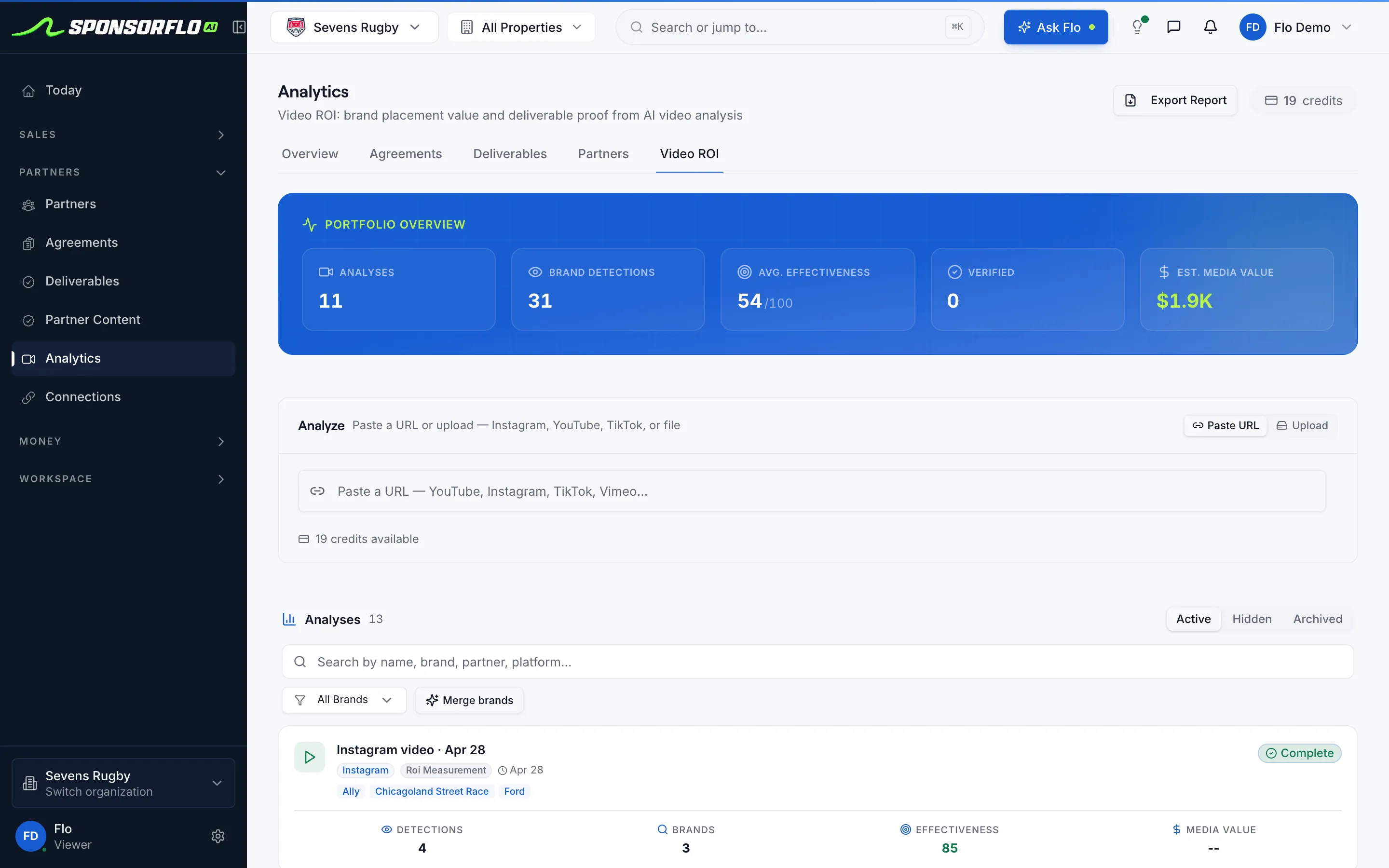
Yes, video is one of the most valuable channels for measuring sponsorship exposure because it captures exactly how long and how prominently a sponsor's logo appeared. SponsorFlo's Video ROI feature analyzes a YouTube, Instagram, TikTok, or X URL — or an uploaded video file — to detect sponsor logos automatically. It returns brand detections, an effectiveness score, and an estimated media value, all of which you can export as a report to include in your ROI calculation or share with a sponsor.
For example, if a sponsor's logo appears on a sideline banner during a highlight reel that reaches 300,000 views on YouTube, Video ROI quantifies that exposure so you are not guessing at a number for your recap.
What is media equivalency value and when should you use it?
Media equivalency value (MEV) estimates what a sponsor would have paid for the same exposure through traditional advertising. It is useful as a baseline comparison because it translates sponsorship placements — a logo on a scoreboard, a name in a podcast read, a banner on a livestream — into a dollar figure the sponsor's media buyer already understands.
MEV works best when you disclose the assumptions behind it. If you price a scoreboard logo at a CPM of $12 based on average attendance of 8,000 per game across 20 home dates, footnote those numbers so the sponsor can see how you arrived at the value. Transparency builds trust and makes renewal conversations easier, because both sides agree on what the exposure is worth.
How often should you measure sponsorship ROI?
Measure sponsorship ROI at least once per deal cycle — after the season, after the event, or at the end of the contract year. Many teams and events also run a mid-season or mid-campaign check to see whether deliverables are on track and whether early metrics suggest the deal will hit its targets.
SponsorFlo's analytics dashboard surfaces pipeline value, conversion rate, and deliverable progress in real time, so you do not have to wait until the recap to spot a deal that is underperforming. If a sponsor's booth package is halfway through the season and only 40% of deliverables have been fulfilled, that is a signal to adjust before the relationship suffers.
- SponsorFlo demo — Watch the product walkthrough or open the live product demo.
- Sponsorship MEV calculator — Estimate media equivalency value across TV, digital, print, radio and signage.
Questions
- How do you calculate sponsorship ROI?
- Sponsorship ROI is calculated by dividing the net value of a sponsorship by its total cost, then multiplying by 100. The formula is: ROI = ((Total Value - Total Cost) / Total Cost) × 100. Total value includes media value, leads generated, and any directly attributable revenue. Total cost includes the rights fee, activation spend, production, and staff time. A positive percentage means the sponsorship returned more value than it cost.
- What is a good ROI for sponsorships?
- There is no single benchmark: results vary widely by industry and sponsorship type, so set your target for your market and deal structure. Some sponsorship value, such as brand awareness, goodwill, and community impact, is harder to quantify but still contributes meaningful business outcomes.
- What metrics should I track for sponsorship ROI?
- Key sponsorship ROI metrics include media equivalency value, social media impressions and engagement, website traffic driven by the sponsorship, leads generated, brand awareness lift from pre- and post-surveys, on-site activation engagement such as samples distributed or sign-ups captured, and direct revenue attribution. Track both quantitative metrics like impressions, clicks, and conversions alongside qualitative metrics like brand sentiment and sponsor satisfaction.
- How do I prove sponsorship value to stakeholders?
- Proving sponsorship value requires combining measurable data with clear storytelling. Build a post-event or post-season recap report that includes total media impressions, engagement metrics, comparable advertising costs showing what the same exposure would cost through paid media, activation highlights with photos and video, survey data on brand recall and purchase intent, and a straightforward ROI calculation. Visual dashboards and side-by-side comparisons make the data easier for executives and finance teams to act on.
- What is media equivalency value (MEV) in sponsorship?
- Media equivalency value (MEV) estimates what a sponsor would pay for equivalent exposure through traditional advertising channels. For example, if a sponsorship logo appears on a broadcast seen by 500,000 viewers, MEV calculates what a 30-second TV ad reaching the same audience would cost. While MEV is widely used, modern sponsorship valuation also incorporates engagement quality, audience demographics, and activation value for a more complete picture of what a deal is worth.