

Sponsorship ticket management
Every seat you promised, and proof the sponsor got it.
Suites, club seats, and guest-list allotments become deliverables on the agreement. Your box office still issues and scans. SponsorFlo keeps what was promised, what was used, and the proof, ready for renewal.
Selling or buying, both sides see the same fulfillment record.
- Promised
- 12 seats, club level, this home date
- Used
- 11 guests, one unused seat noted
- Proof
- headcountsuite.jpg
Two layers, two jobs.
SponsorFlo sits above your ticketing system and tracks the sponsorship promise.
What the contract promised
- Suites, club seats, and guest lists
- Due dates tied to each event night
- Proof and makegoods on the agreement
Getting guests through the door
- Ticketmaster, Paciolan, or your team's box office
- Issuing and scanning still happens there
- SponsorFlo never replaces the scan
Watch SponsorFlo run a sponsorship season
See Sevens Rugby move from inventory and research through Deck Studio, agreements, deliverables, and renewals — the full seller season in one walkthrough.
A season of suite nights, counted.
A regional bank sponsors your basketball team: a 12-person suite for ten home games. One deliverable per night, closed with a headcount and proof.
What the sponsor was promised
Seat count, section, night, and any guest-of rules live as a deliverable on the agreement.
- – Count, section, and date on the line
- – Named guests when the contract requires them
- – Hospitality written separately when it is a separate promise
Getting guests through the door
Your box office still issues and scans. SponsorFlo records seats used versus promised, a photo, or a named shortfall.
- – Headcount against the contracted seats
- – A photo of the suite or section
- – A makegood on the same row if the night fell short
Seats are one promise. The catering and the room are another. Track them separately, so a late buffet does not blur whether the sponsor got their seats.
Tickets and hospitality, side by side.
When a contract promises both, each gets its own deliverable, its own proof, and its own status. Brands see both in Brand HQ.
See hospitality trackingWhat it looks like in SponsorFlo.
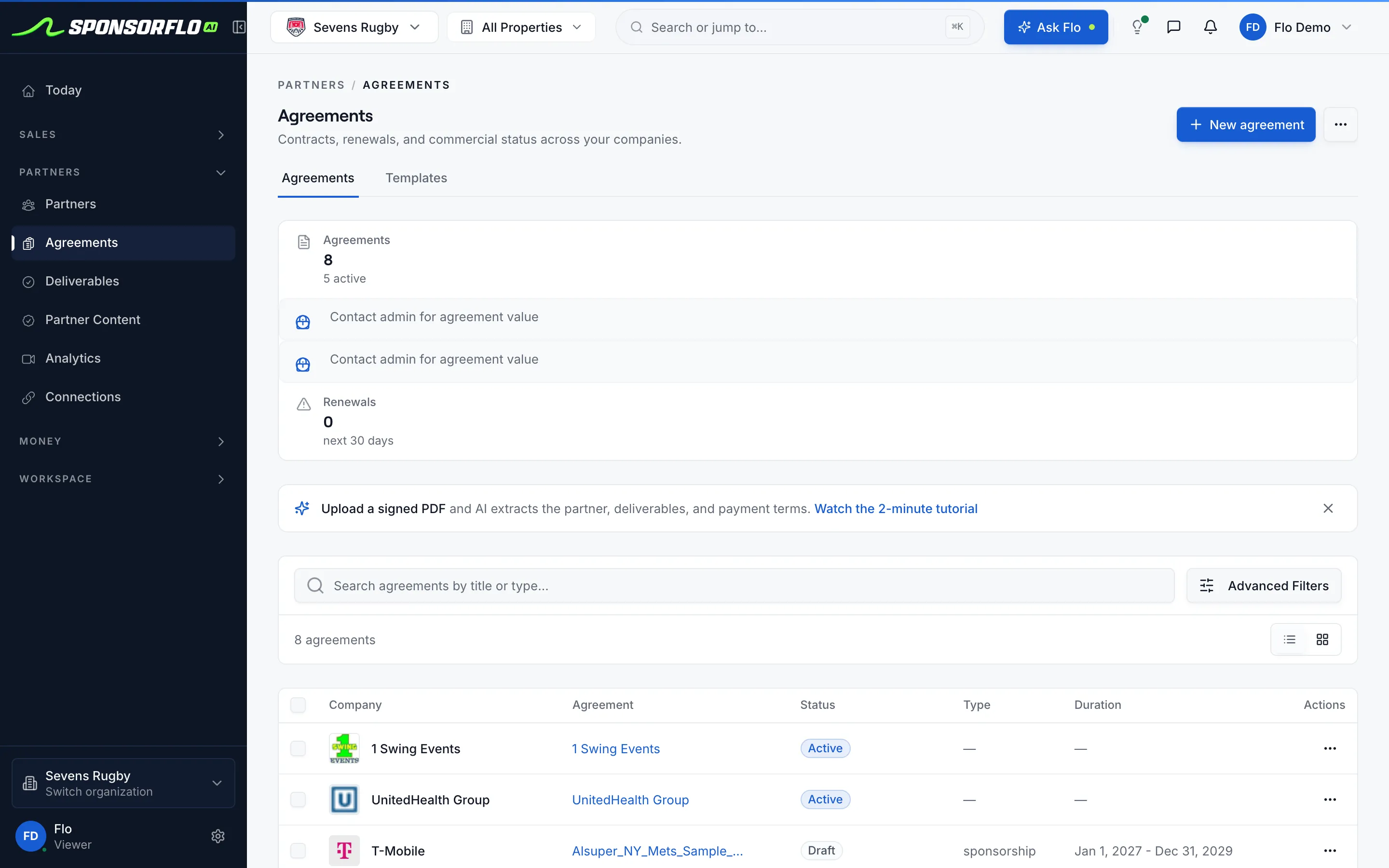
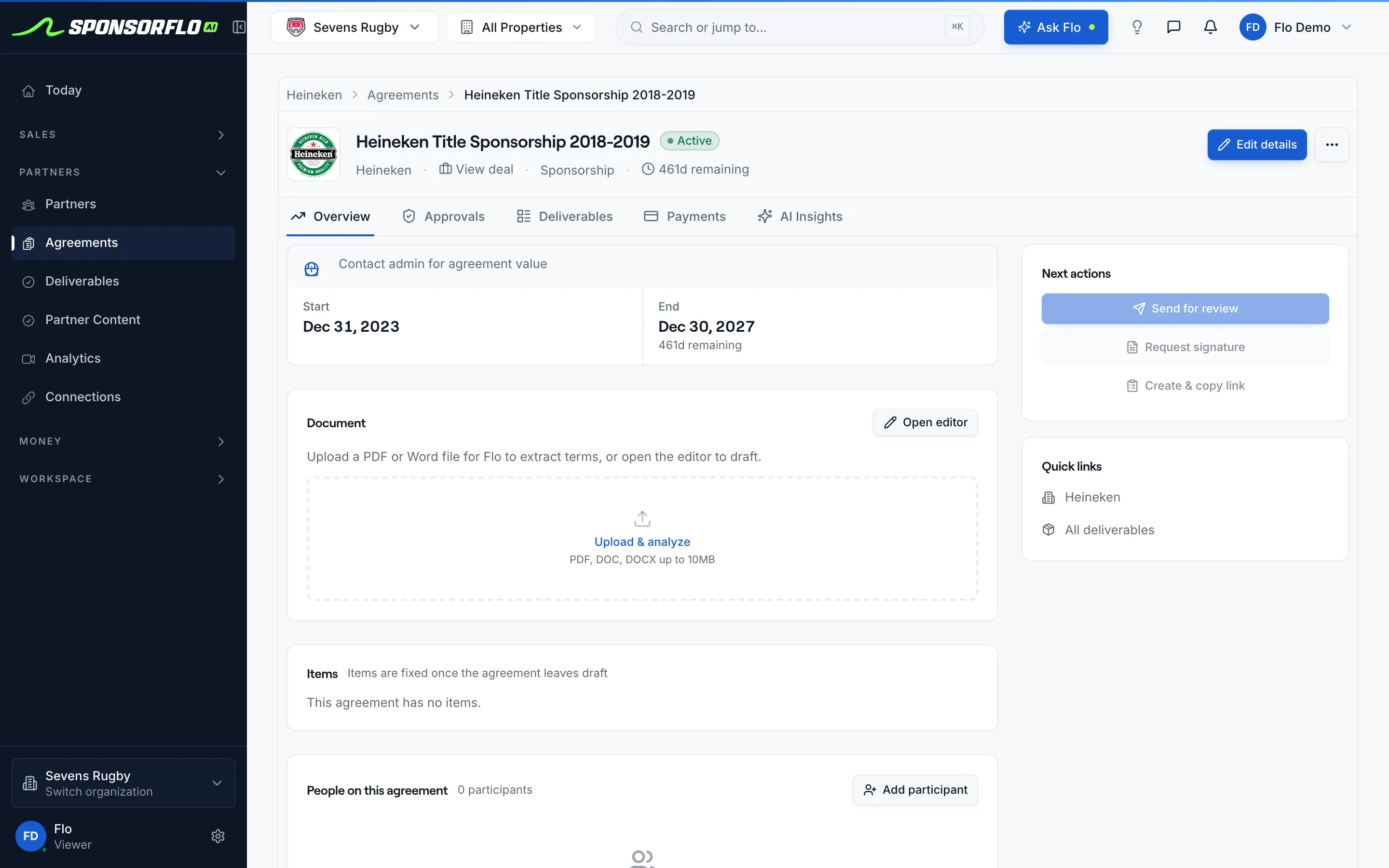
Agreements and the lines extracted from them, including ticket commitments.
Questions
Brand side? See allotments across your portfolio in Brand HQ.
What is sponsorship ticket management software?
It tracks the ticket allotments in sponsor agreements, such as suites, club seats, and guest lists, as deliverables with due dates and proof, then closes each one after the event.
Does SponsorFlo issue or scan tickets?
No. Ticketmaster, Paciolan, or your box office still does that. SponsorFlo tracks the contracted allotment and the proof it was fulfilled.
How do you close a ticket allotment after the event?
Mark it completed and attach proof: seats used versus promised, a photo, a guest list if required, or a named shortfall with a makegood.
How is ticket management different from hospitality tracking?
Tickets are the seats. Hospitality is the room, food, and experience. When they are separate promises, they are separate deliverables.
Can sponsors see their ticket allotments?
Yes, through a shared Partner Portal link, or in Brand HQ for brands with several sponsorships.
Can AI extract ticket commitments from the contract?
Yes. Upload the signed agreement and AI extracts ticket commitments along with other benefits, so you do not retype them.
Sponsorship ticket management
The process of recording, fulfilling, and proving the ticket allotments in a sponsor agreement: suites, club seats, and guest-list commitments tracked as deliverables with seat counts, section details, event dates, and proof of fulfillment after the night.
Read the full sponsorship ticket management guide
Sponsorship ticket management: how to track allotments, proof, and fulfillment
Sponsorship ticket management is how teams, venues, and brands track the ticket allotments written into sponsor agreements. For a sports team promising a suite on opening night or a festival allotting VIP seats to a title sponsor, the question is the same: did the sponsor get the seats they were promised, and can you prove it at renewal? SponsorFlo tracks every allotment as a deliverable on the agreement, with a due date, proof attachments, and a fulfillment status that follows the sponsor from the first deal through every season after.
What is sponsorship ticket management?
Sponsorship ticket management is the discipline of tracking every ticket benefit a sponsor has been promised, making sure it gets delivered, and documenting what happened. Most partnership teams handle dozens of allotments per season across suites, club seats, and guest lists. Without a structured record, renewal conversations rely on memory, and shortfalls go unaddressed until the sponsor brings them up. A sponsorship ticket management tool puts the allotment on the agreement as a deliverable, so it is tracked the same way you would track a logo placement or a social media post.
What belongs on a ticket allotment deliverable?
Every ticket allotment should capture enough detail that someone who was not at the event can confirm what the sponsor received. That means recording four things before the event and attaching proof afterward.
- Seat count: how many seats, whether it is a full suite or a block of club seats.
- Section and location: the suite number, the row and seat range, or the hospitality area.
- Event date: which game, match, or event night the allotment covers.
- Guest-of rules: whether the contract requires named guests or allows the sponsor to distribute seats freely.
After the event, close the deliverable with proof: a photo of the suite setup, a guest list if names were required, or a count of seats used versus seats promised. If the allotment fell short—empty seats, a relocated row, a canceled event—name the shortfall on the deliverable and log a make-good on the same sponsor’s record.
How do you track sponsor ticket allotments in SponsorFlo?
In SponsorFlo, ticket allotments are deliverables on the sponsor’s agreement. When you upload a signed contract, AI can extract the promised benefits, including ticket commitments, so you do not retype them. Each deliverable gets a status, a due date, and a priority. After the event, attach proof—a photo, a file, or a link—and mark the deliverable as completed. The deliverables view shows what is completed, in progress, and overdue for every sponsor, so you can catch a missed allotment before the sponsor does.
For example, imagine a regional bank sponsors your basketball team and the contract includes a twelve-person suite for ten home games. You would create one deliverable per game night, each with a due date, the suite number, and the headcount. After each game, your partnership coordinator attaches a photo of the suite and logs the actual headcount. By season’s end, you have a complete record showing the bank received all ten nights, with photos to prove it.
How is sponsorship ticket management different from ticketing software?
SponsorFlo does not issue or scan tickets. Ticketmaster, Paciolan, or your team’s box office handles ticket distribution, access control, and scanning. SponsorFlo tracks the contracted allotment—what the sponsor was promised and whether it was fulfilled—as a deliverable on the agreement. Think of it as the sponsorship layer that sits above the ticketing system: the box office makes sure guests get through the door, and SponsorFlo makes sure you can prove it happened when the renewal conversation starts.
How do you handle shortfalls and make-goods?
When an allotment falls short—the suite was double-booked, the sponsor’s guests were moved to a different section, or the event was canceled—name the shortfall on the deliverable instead of leaving it unmarked. Then log a make-good on the same sponsor’s record so it is visible the next time you review their deliverables. Addressing a shortfall proactively, before the sponsor raises it, protects the relationship and gives you a stronger position at renewal.
How do brands track their ticket allotments?
Brands that sponsor multiple teams or events can see every ticket and hospitality deliverable each property owes them in SponsorFlo’s Brand HQ. The deliverables view shows status, proof, and completion across the portfolio, so a brand partnership manager knows which properties delivered what they promised and which fell short. When tickets and hospitality are separate promises in the contract, they appear as separate deliverables, each with its own proof and fulfillment record.
Using ticket fulfillment records in renewal conversations
Renewals go better when both sides can see exactly what was delivered. Instead of recalling from memory whether the sponsor used all ten suite nights, pull up the deliverables with attached photos and headcounts. A complete fulfillment record does three things: it proves you delivered what you promised, it shows the sponsor the value they received, and it gives you evidence to propose an upgrade—more nights, a better suite, or additional club seats—backed by data rather than a pitch.
Starting the renewal conversation a few months before the contract ends gives the sponsor time to budget and gives you time to address any fulfillment gaps. When the allotment record is already complete, that conversation takes minutes instead of weeks of digging through emails and spreadsheets.
Property-side allotment writing
Partnership operations writes the allotment before the game: the seat count, section, night, and guest-of rules. After the event, the coordinator attaches a photo of the suite or a guest list export. The ticketing desk’s scan data stays in the primary ticketing system—the deliverable in SponsorFlo holds what the sponsor bought and what ran.
- Suite: night, location, and headcount cap recorded as a deliverable with a due date.
- Club seats: row block and transfer rules written on the agreement so next season’s renewal references the exact allocation.
- Guest list: names attached as proof when the contract requires them.
- Shortfall: empty seats or relocated rows named on the deliverable, with a make-good logged on the same sponsor.
Related pages
- Brand hospitality — track hospitality nights and experiences on the agreement
- For brands — see allotments and deliverables across your portfolio in Brand HQ
- Sports teams — manage suite inventory and sponsor deliverables for your venue
- Brand deliverables — track every sponsor benefit from due date to proof of performance
Related solutions
Brand hospitality
Track hospitality nights and experiences on the agreement
Learn moreSolutionFor brands
See allotments and deliverables across your portfolio in Brand HQ
Learn moreSolutionSports teams
Manage suite inventory and sponsor deliverables for your venue
Learn moreSolutionBrand deliverables
Track every sponsor benefit from due date to proof of performance
Learn moreCount every seat before the sponsor asks.
Open the demo workspace to see allotments, proof, and makegoods on real agreements.