What does it take to sell sponsorships well?
Sponsorship sales combines relationship building, consultative selling, and project management. The best sponsorship sellers do not blast a generic rate card to a purchased list; they research each prospect, tailor a proposal, and follow up with specific proof that the partnership will deliver results.
The eight stages below give you a framework you can adapt whether you sell sponsorships for a sports team, a music festival, a nonprofit gala, or a podcast.
What are the stages of the sponsorship sales process?
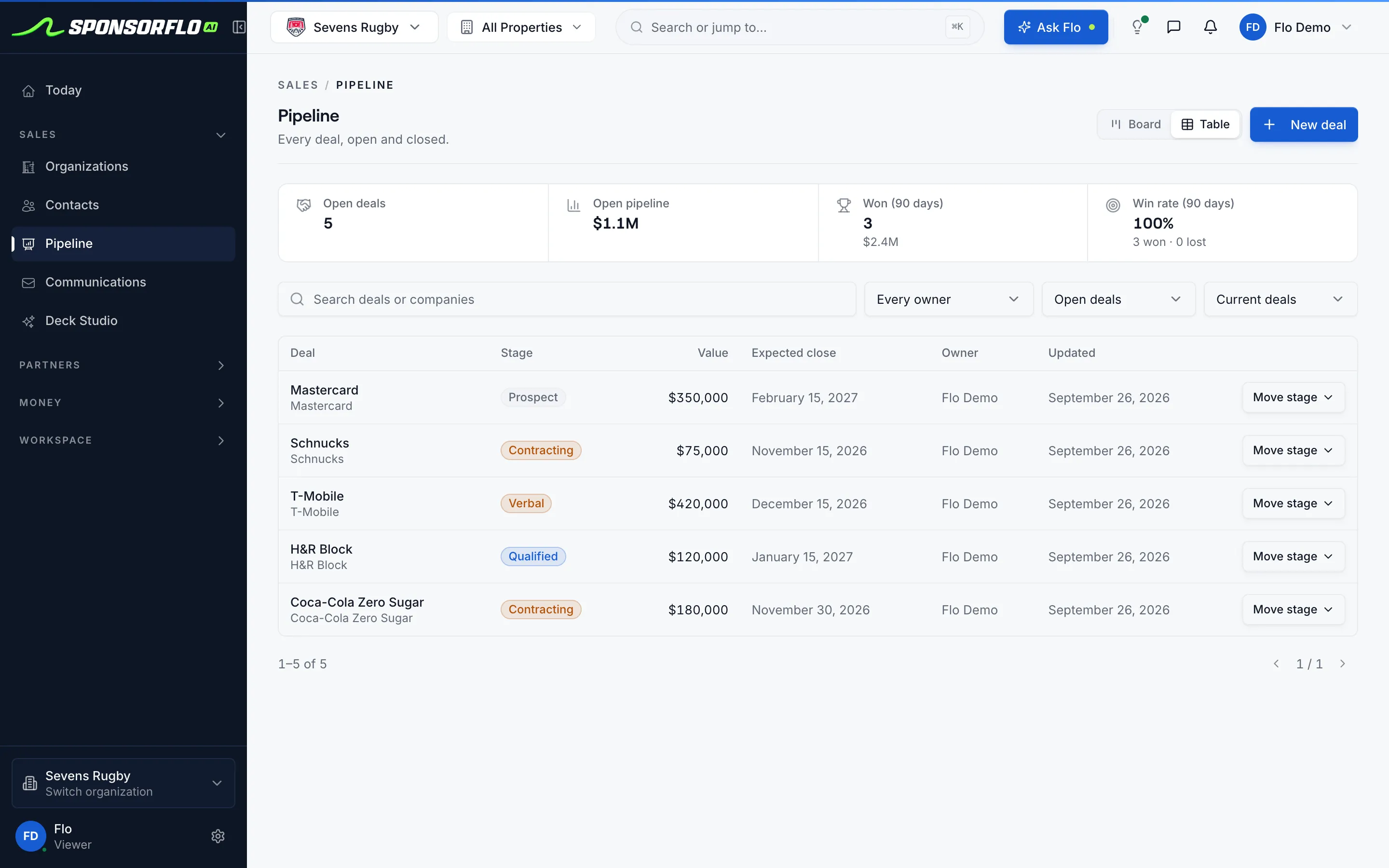
Sponsorship sales runs in eight stages: prospecting and research, initial outreach, discovery, proposal development, presentation, objection handling, negotiation and closing, and onboarding and fulfillment. Each stage has a clear job that moves the deal forward.
1. Prospecting and research
Identify companies whose customers overlap with your audience, then find the marketing or partnerships contact who controls sponsorship budget.
- Build an ideal sponsor profile based on audience overlap.
- Research each company's recent marketing campaigns.
- Identify the decision-maker and any internal champion.
- Look for warm introductions through mutual connections.
2. Initial outreach
Send a short, personalized message that explains why this sponsor is a fit and asks for a brief call, not a long pitch over email.
- Personalize the opening line to their brand or campaign.
- Connect on LinkedIn before or after the first email.
- Follow up by phone with a specific value point.
- Reference a mutual connection or shared audience.
3. Discovery and needs analysis
Ask what the sponsor wants to achieve, such as brand awareness, leads, hospitality, or content, and how they measure success, so your proposal addresses their actual goals.
- Ask about their top marketing objectives this quarter.
- Learn which demographics they want to reach.
- Understand their budget range and approval process.
- Map who else needs to approve the deal.
4. Proposal development
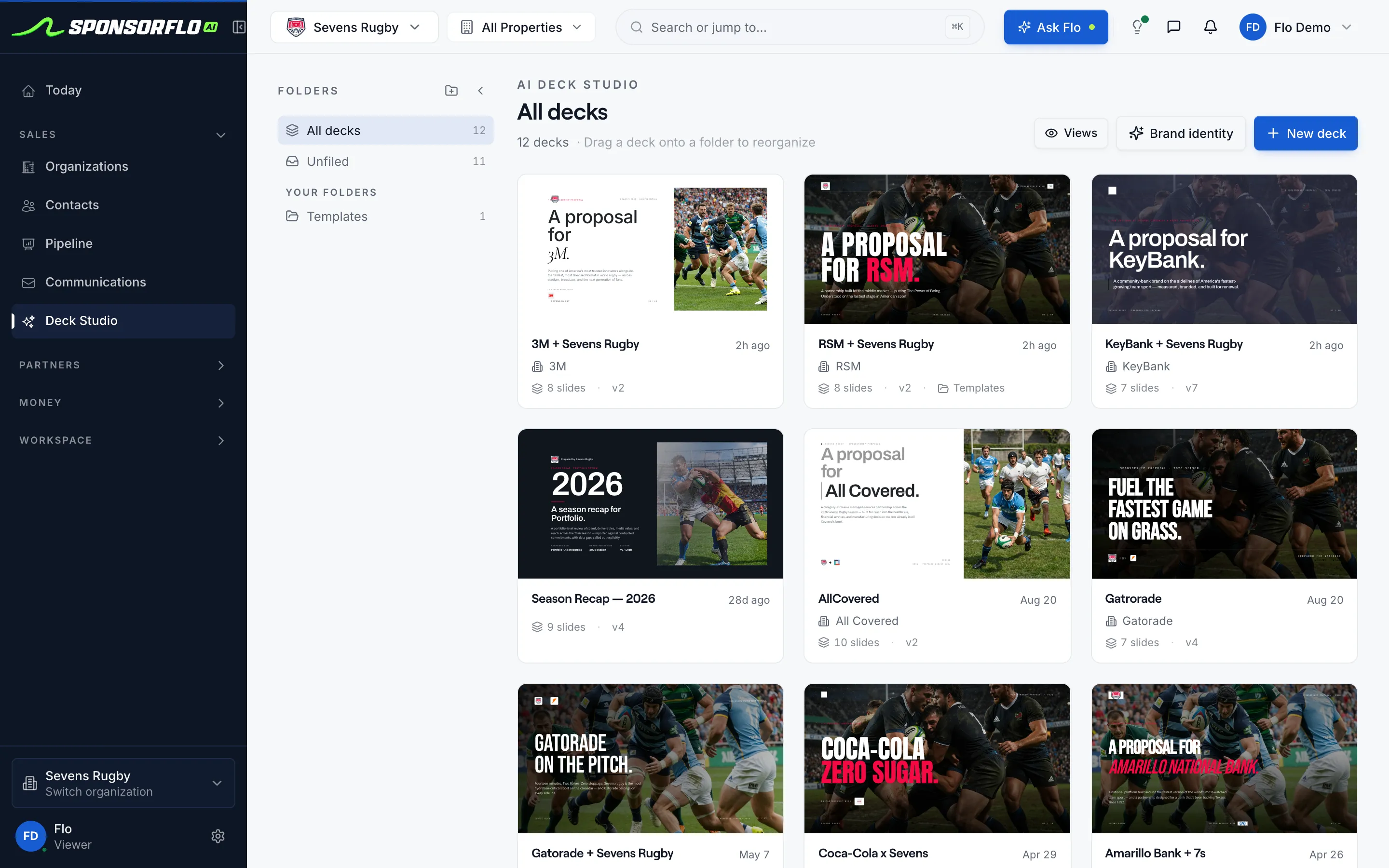
Build a proposal that connects each deliverable to the sponsor's stated goals, with clear pricing and a visual mockup of their logo on your assets.
- Tailor package tiers to objectives from the discovery call.
- Include audience data and estimated impressions.
- Show a mockup of the sponsor's logo on a jersey, banner, or stage.
- Present a clear price with what is included at each level.
5. Presentation and pitch
Walk the sponsor through the proposal in a live meeting so you can answer questions in real time and gauge their reaction to each deliverable.
- Open with a story about a past activation that worked.
- Use photos and data slides, not walls of text.
- Show how each deliverable maps to their goals.
- End with a clear next step and timeline.
6. Objection handling
Listen to each concern fully, then respond with specifics, such as a smaller package, a different asset, or a payment schedule, rather than repeating the pitch.
- Pause and acknowledge the concern before responding.
- Provide a specific example or data point.
- Offer a flexible alternative that still delivers value.
- Reframe the conversation around their stated goals.
7. Negotiation and closing
Anchor with your published rate, negotiate on scope rather than discounting price, and move to a written agreement as soon as terms are agreed.
- Start with your published asking price as the anchor.
- Bundle assets to increase perceived value.
- Use a trial close to test readiness before the final ask.
- Structure the agreement so both sides win.
8. Onboarding and fulfillment
Deliver on every promised benefit, share proof of performance along the way, and set up the renewal conversation before the contract ends.
- Send a welcome package with timelines and contacts.
- Set expectations for deliverable dates and proof reports.
- Share early wins within the first 30 days.
- Schedule regular check-ins through the contract term.
How do you handle common sponsorship objections?
Every sponsorship seller hears the same objections. The key is to listen, acknowledge the concern, and respond with a specific solution rather than a rehearsed rebuttal.
“Your price is too high”
Break down the cost per impression or cost per attendee so the sponsor can compare your package against other media buys. If the total is still above budget, adjust the package scope, for example by removing a booth but keeping the logo on the jersey, rather than discounting the rate.“We need to think about it”
Ask which part they want to discuss internally so you can provide supporting materials for that specific question. Agree on a follow-up date and send a short recap email the same day that restates the key benefits.“We’re already working with a competitor”
Ask what they like and what they wish were different about that partnership. Position your opportunity as complementary if it reaches a different audience segment, or note when their current deal ends so you can re-engage before renewal.“We don’t have budget right now”
Find out when their next budget cycle starts and offer to present a proposal timed for that window. In the meantime, suggest a smaller activation, such as a single event or a digital-only package, that fits within discretionary spend.“We need to see results first”
Offer a one-event or one-season pilot with defined success metrics agreed in advance. Share examples of similar activations, such as a booth package at a comparable event or a podcast read for a similar audience, and the impressions those delivered.“Your audience doesn’t match ours”
Share detailed audience demographics, including age, income, geography, and interests, and highlight where the overlap exists. If only a segment matches, propose a targeted package, such as a VIP hospitality experience, that reaches that specific group.
What are the best closing techniques for sponsorship deals?
The right closing technique depends on the sponsor's personality and where they are in their decision process. These five approaches can be mixed and matched.
The assumptive close
Move the conversation to logistics as though agreement is a given, which signals confidence and keeps momentum.Example: “When would you like the activation to begin, before or after your product launch?”The alternatives close
Give the sponsor a choice between two packages rather than a yes-or-no question, so either answer moves the deal forward.Example: “Would the gold or platinum package work better for your goals?”The urgency close
Mention a real constraint, such as limited inventory, a print deadline, or an upcoming event, that makes acting now more advantageous than waiting.Example: “We have one premium sideline spot left for this season, and the artwork deadline is next Friday.”The summary close
Recap every benefit the sponsor agreed was important during discovery, then ask a direct closing question.Example: “You said brand awareness and reaching families in the metro area were your priorities, and this package delivers both. Are you ready to move forward?”The trial close
Ask a softer question mid-conversation to gauge readiness without putting pressure on a final answer.Example: “How does this approach align with your marketing objectives so far?”
What are sponsorship sales best practices?
Research every prospect, frame each deliverable around the sponsor's goals, and keep delivering proof of performance after the contract is signed. Avoid generic decks, pressure tactics, and promises you cannot track.
Do these
- Research each prospect's recent campaigns and audience before you reach out.
- Frame every deliverable in terms of what it does for the sponsor's business.
- Support your pricing with audience data, attendance figures, or impression estimates.
- Follow up consistently, adding a new proof point each time instead of a generic “checking in.”
- Invest in the relationship beyond the transaction, year over year.
- Customize every proposal so the sponsor sees their logo and their goals on the page.
Avoid these
- Sending the same generic deck to every prospect on your list.
- Leading with your features instead of the sponsor's goals.
- Pressuring a prospect into a decision before they have internal buy-in.
- Ignoring a sponsor's stated budget range and pitching above it without justification.
- Promising deliverables you cannot track or fulfill.
- Disappearing after the contract is signed instead of delivering proof of performance.
How to sell sponsorships: strategy, process, and common mistakes
Selling sponsorships is the process of finding companies whose target audience overlaps with yours, packaging your assets — signage, digital placements, hospitality, content — into a proposal that meets their marketing objectives, and closing a deal that delivers measurable value to both sides. Whether you sell sponsorships for a youth sports league, a 20,000-seat arena, a nonprofit fundraiser, or a podcast, the underlying process is the same: research, outreach, discovery, proposal, negotiation, agreement, and fulfillment.
Sponsorship sales
Sponsorship sales is the practice of identifying, pitching, and closing deals with companies that pay to associate their brand with an event, team, venue, or content property in exchange for agreed-upon marketing benefits such as logo placement, booth space, naming rights, or digital impressions.
What does a sponsorship sales process look like?
A sponsorship sales process typically follows seven or eight stages, each with a clear output that moves the deal forward. The stages below apply whether you are selling a $500 local event package or a $500,000 naming-rights deal.
- Prospecting — Identify companies whose customer demographics match your audience. Look at brands that already sponsor similar properties, companies advertising in your market, and businesses that have publicly stated growth goals your audience can help them reach.
- Research — Before you contact anyone, learn the prospect's recent campaigns, product launches, and marketing priorities. Find the person who manages sponsorships or partnerships; in smaller companies that may be the CMO or the owner.
- Outreach — Send a short, personalized email that explains why their brand is a fit for your audience. Reference something specific about their business, attach or link to a one-page overview, and ask for a 20-minute call.
- Discovery — On the call, ask what the sponsor wants to achieve (brand awareness, lead generation, hospitality, content) and how they measure success. This conversation shapes everything in your proposal.
- Proposal — Build a deck that maps each deliverable to the goals the sponsor shared. Include audience data, a visual mockup of their logo on your assets (a jersey patch, a banner behind the stage, a podcast intro card), and clear pricing.
- Negotiation — Discuss scope and price. Negotiate on what is included rather than simply discounting. For example, if a sponsor's budget is below your asking price, remove one deliverable instead of cutting your rate across the board.
- Agreement — Move to a written contract that lists every deliverable, its due date, the total price, and the payment schedule. Both sides sign before activation begins.
- Fulfillment and renewal — Deliver every promised benefit, share proof of performance (photos, impression counts, recap reports), and begin the renewal conversation at least 60 days before the contract ends.
How do you find sponsorship prospects?
The best sponsorship prospects are companies that already spend money reaching an audience similar to yours. Start with three sources. First, look at who sponsors comparable properties — a rival team, a conference in the same industry, or a podcast with a similar listener profile. Second, review local and national advertisers in your market; a company buying billboards or digital ads near your venue may be open to a sponsorship that includes experiential benefits they cannot get from a billboard. Third, ask your existing sponsors, board members, or volunteers for introductions. Warm introductions convert at a much higher rate than cold emails because the prospect already trusts the person making the connection.
What should a sponsorship proposal include?
A strong sponsorship proposal includes five elements: a brief overview of your property and audience, the sponsor's goals (pulled directly from your discovery conversation), a package of deliverables mapped to those goals, pricing, and a visual mockup. The mockup is especially important because it helps the sponsor's internal team picture the partnership. Showing a prospect their logo on your scoreboard or your event t-shirt is far more persuasive than listing 'logo placement' as a bullet point.
Structure your pricing in tiers when possible — for example, a presenting sponsor tier, a supporting sponsor tier, and a community partner tier. Tiers give the prospect a choice rather than a yes-or-no decision, and they anchor the conversation around the higher-value package.
How do you handle price objections in sponsorship sales?
Price objections almost always mean the prospect does not yet see enough value relative to the cost, not that they have zero budget. Respond by breaking the price into a cost-per-impression or cost-per-attendee figure so the sponsor can compare your package to other marketing channels. If a booth package costs $5,000 and your event draws 8,000 attendees, that is $0.63 per person — often less than the cost of a targeted social media ad reaching the same demographic.
If the sponsor's budget is genuinely below your asking price, adjust scope instead of discounting. Remove a deliverable, shorten the term to a single event instead of a full season, or offer a digital-only package with lower production costs. Discounting the rate trains the sponsor to negotiate harder next year.
What is the best way to follow up after sending a sponsorship proposal?
The most effective follow-up adds new information rather than simply asking whether the prospect had a chance to review your deck. For example, send a short email three days after the proposal with a photo from your last event, an attendance figure, or a relevant news clip. Each follow-up gives the sponsor a new reason to engage instead of feeling pressured.
Space your follow-ups about three to five business days apart. After three or four touches with no reply, send a brief email offering to adjust the package or timeline and let the prospect know you will check back next quarter. Persistence matters, but so does professionalism.
How do you deliver proof of performance to sponsors?
Proof of performance is documentation that shows a sponsor their promised deliverables were fulfilled. It typically includes photos of signage or logo placement, screenshots of digital impressions, attendance or viewership numbers, and social media metrics. Delivering proof throughout the contract — not just in a recap report at the end — keeps the sponsor engaged and builds confidence in the partnership.
For example, after a game or event, send the sponsor two or three photos showing their banner in the venue and a quick note on attendance. At the midpoint of a season-long deal, share a summary of impressions delivered so far versus the total promised. This ongoing communication makes the renewal conversation much easier because the sponsor already has evidence the partnership is working.
What mistakes should you avoid when selling sponsorships?
The most common mistake is sending a generic rate card to a long list of prospects and hoping someone responds. Sponsorship is a relationship sale; the proposal should reflect the prospect's specific goals, not a one-size-fits-all menu. Other frequent mistakes include leading with your property's features ("we have 10,000 fans") instead of the sponsor's outcomes ("your brand will reach 10,000 local families who match your target demographic"), failing to follow up after the first email, and promising deliverables you cannot track or measure.
After the deal closes, many sellers make the mistake of disappearing until renewal time. Sponsors who do not hear from you during the contract are far less likely to renew. Stay in touch, share proof of performance, and treat fulfillment as the first step of next year's sales process.
- Sponsorship proposal templates — Download sample layouts and learn which sections close deals.
- Sponsorship ROI calculator — Estimate the return on a sponsorship package and share the numbers with prospects.