
Sponsor retention strategies: how to turn fulfilled deliverables into renewed partnerships
Sponsor retention strategies determine whether a partnership lasts one season or five. For a team, event, or nonprofit that sells sponsorships, retention comes down to three things: delivering every benefit the contract promised, proving that value with a recap the sponsor can share internally, and starting the renewal conversation while the results are still fresh. SponsorFlo tracks deliverables against the signed agreement, keeps proof on the deal record, and gives you a complete history to build from when it is time to renew.
What are the most effective sponsor retention strategies?
The most effective sponsor retention strategies focus on three actions that repeat for every deal: fulfill every contracted deliverable on time, send a recap that compares what you promised with what you delivered, and open the renewal conversation while the event or season is still in the sponsor's mind. Each action builds trust, and together they make the renewal feel like a natural next step rather than a new sales pitch.
Retention fails most often when fulfillment is invisible. If a sponsor has to guess whether their signage went up or their social post ran, they walk into the renewal meeting skeptical. The fix is straightforward: track each deliverable with a due date and attach proof, such as a photo of the jersey patch on the field or a link to the Instagram story, so the sponsor sees value accumulating throughout the season.
How to track deliverables so nothing is missed
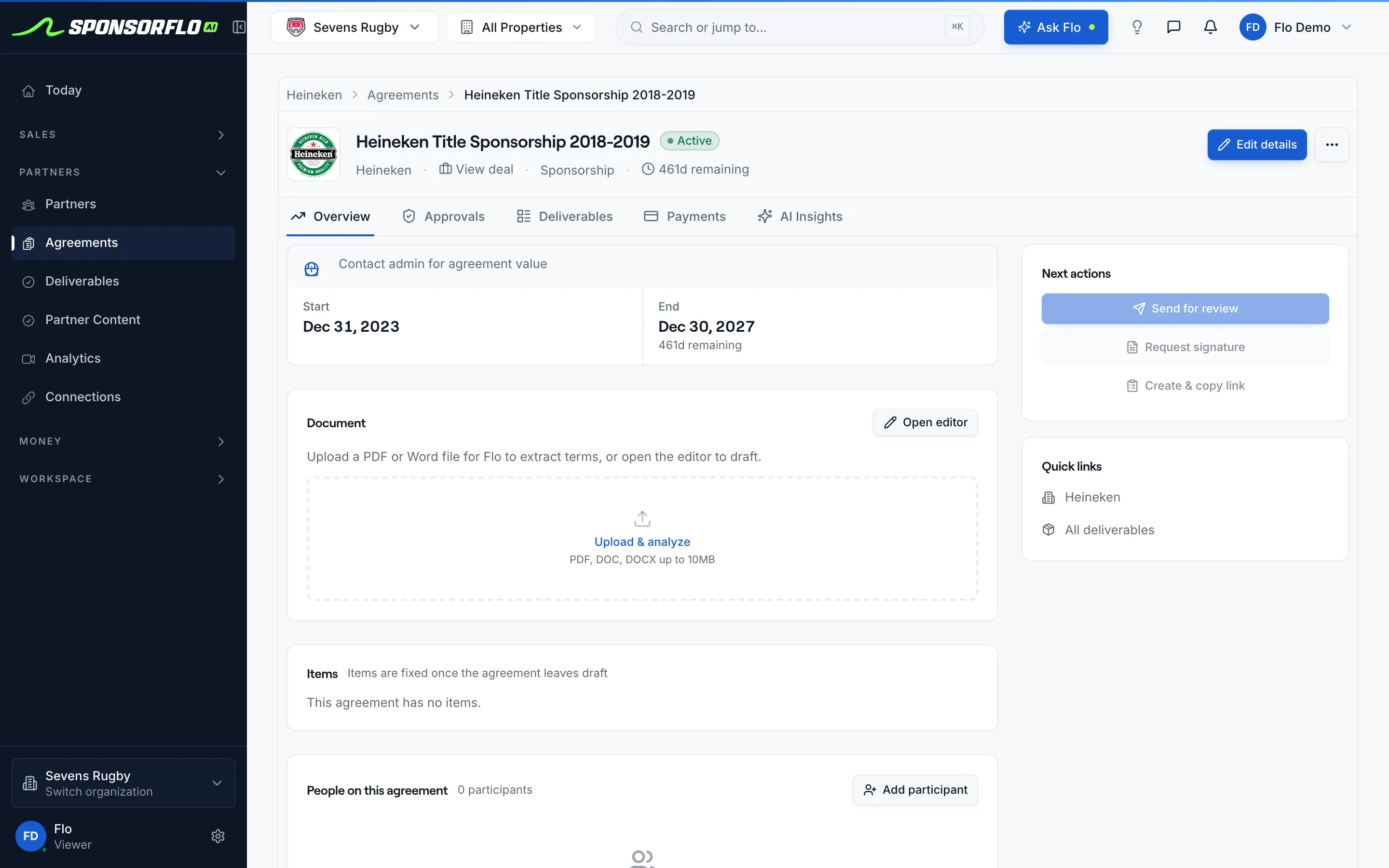
List every benefit the contract promises as a deliverable with a status, a due date, and a priority. As each one runs, attach proof: a photo of the booth signage, a link to the podcast read, a screenshot of the digital banner. SponsorFlo can extract deliverables from a signed agreement so you do not retype them, and the deliverables view shows what is completed, in progress, and overdue for every sponsor at a glance.
Overdue deliverables are the fastest path to churn. Catching a missed placement mid-season gives you time to offer a make-good, such as an extra social mention or a bonus digital impression, before the sponsor loses confidence. A sponsor who learns about a shortfall from you first is far more likely to renew than one who discovers it in the recap.
How to build a recap that opens the renewal conversation
A strong recap compares promised deliverables with delivered results, includes at least one piece of visual proof per major benefit, and ends with a recommendation for next season. Send it within two weeks of the final deliverable while the event is still in memory. For example, a minor league team might send the recap showing that the sponsor received all ten in-stadium signage placements, three social posts that generated a combined impression count, and a 30-second video clip where the logo appeared on the broadcast feed.
In SponsorFlo, the recap draws from deliverables already logged on the deal record, so building it is assembly rather than research. Attach the recap to the same email thread as the original deck so the sponsor can scroll back to the proposal and see how the partnership delivered against what was promised.
When should you start the renewal conversation?
Start weeks after the last deliverable runs, not months later. Most brand marketing budgets lock three to six months before the next fiscal year, so waiting until the off-season often means the money has already been committed elsewhere. Attaching the recap to the renewal outreach keeps the proof fresh and gives the sponsor a document they can forward to their own leadership to justify the spend.
Opening the next agreement on the same deal record in SponsorFlo means the original contract, every deliverable with its proof, and the full communication history are available during the negotiation. You do not need to rebuild context from scattered emails and spreadsheets.
How do you handle a sponsor who only used part of their package?
A sponsor who skipped hospitality seats or activated only half the placements may still see value in the media exposure they did receive. Rather than proposing the same package at the same price, offer a trimmed set of deliverables that matches what they actually used. A booth package sponsor who never staffed the booth, for example, might prefer a signage-only deal at a lower price point. Addressing the gap honestly in the recap, before renewal, shows the sponsor you are paying attention and makes the smaller proposal feel like a thoughtful recommendation, not a desperate save.
Using proof of value to justify the renewal price
Renewals go better when both sides look at the same numbers. Bring the deliverables that ran, the impressions they generated, and the media value measured from video alongside the original contract. SponsorFlo's Video ROI feature estimates media value from sponsor logo exposure detected in game footage and social clips, giving you a concrete number to present. For instance, showing a sponsor that their logo appeared for a combined 47 seconds across six social clips, with an estimated media value you can both discuss, is more persuasive than a slide that says the partnership was successful.
For brands that sponsor multiple properties, SponsorFlo's Brand HQ Performance view compares impressions, reach, media value, and total spend across the entire portfolio. A brand partnership manager can see which properties delivered and which fell short, making the renewal decision data-driven rather than political.
Signals that predict whether a sponsor will renew
- They reply to the recap, even briefly: engagement means the relationship is active and the renewal conversation has a willing participant.
- They used the hospitality: filled seats and attended events show the sponsor values the relationship beyond media placement.
- They requested a mid-season change: a swap request means they are invested in making the partnership work, not planning to leave.
- They went silent after the last event: silence is the clearest warning sign, and the time to act is now, before they finalize next year's budget.
- Their contract ends within six months: start the renewal conversation immediately so you are not competing with other properties for a locked budget.
How does SponsorFlo help with sponsor retention?
SponsorFlo gives you a single deal record that holds the signed agreement, every deliverable with its status and proof, the email thread from your connected Gmail or Outlook inbox, and the renewal proposal. You do not need to reconstruct the partnership's history from a spreadsheet and a shared drive. When it is time to renew, the recap builds itself from work you already did, and the next agreement starts on the same record so nothing is lost between seasons.
Deck Studio builds a branded renewal deck from your inventory, complete with sponsor logo mockups on your own asset photos. When you send it as a tracked link, SponsorFlo reports when the sponsor views the deck, so you know the right moment to follow up. The AI assistant, Flo, can answer questions about the deal's history, and AI-drafted follow-up emails reference the specific deliverables and proof already on the record.
A weekly retention checklist
- Check the deliverables view for anything overdue and fix it before the sponsor notices.
- Review deals with contract terms ending in the next 180 days and prioritize renewal outreach.
- Send the recap to any sponsor whose final deliverable ran in the past two weeks.
- Follow up with any sponsor who viewed the renewal deck but has not replied.
- Log proof for every deliverable that ran this week so the recap is ready when you need it.
- Recap report template — build the promised-versus-delivered recap that opens the renewal conversation
- Sponsorship sales guide — the full sales process from prospecting through close