
Compare
SponsorFlo vs Sponsorium: outbound sales vs inbound request triage.
Sponsorium, whose PerforMind software now lives at sponsor.com, helps corporate sponsors score and triage inbound sponsorship requests. SponsorFlo helps teams, events, and nonprofits build branded decks, manage a sales pipeline, and track deliverables through proof of performance. They share a category phrase but serve opposite sides of the sponsorship deal.
Reviewed October 5, 2026. Written by SponsorFlo, so confirm Sponsorium details in its own demo.
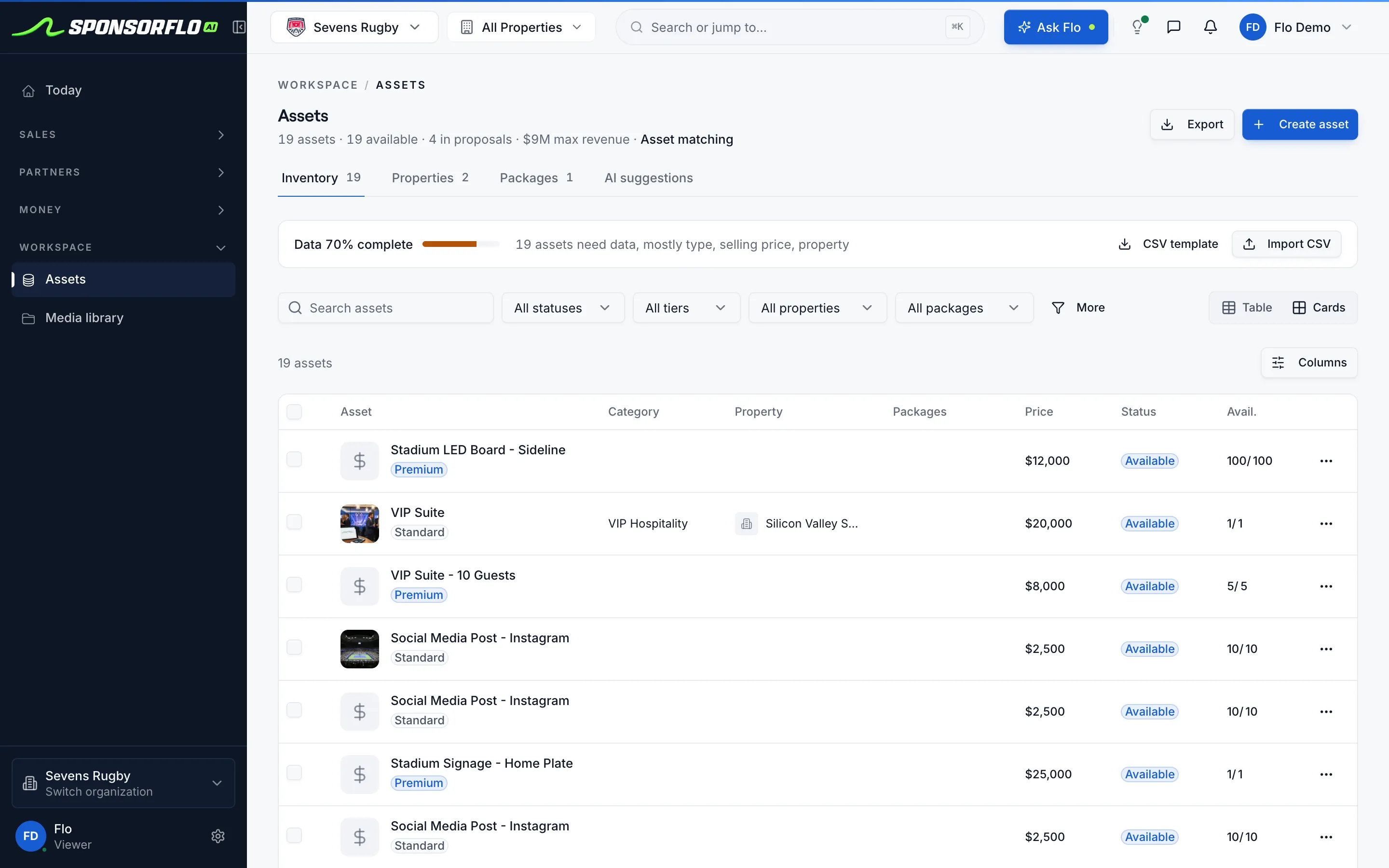
How do SponsorFlo and Sponsorium compare?
They sit on opposite sides of the same deal: SponsorFlo helps the property that sells the sponsorship, and Sponsorium helps the brand that receives the request. Compare the motion first, then the features.
| Criterion | SponsorFlo | Sponsorium |
|---|---|---|
| Primary motion | Outbound: build a deck from your inventory and pitch sponsors | Inbound: score and triage sponsorship requests from properties |
| Typical buyer | Teams, events, venues, and nonprofits that sell sponsorships, plus brand partnership teams in Brand HQ | Corporate brands and foundations evaluating incoming requests |
| AI deck builder | Deck Studio builds branded decks with sponsor logo mockups | Not applicable — Sponsorium scores inbound asks, not outbound pitches |
| Deliverable fulfillment | Deliverables with status, due date, proof, and impressions on each agreement, shown to sponsors in a partner portal | Brand portfolio tracking, not rights-holder fulfillment |
| Agreements and e-signature | Redlines, internal approvals, built-in e-signature, and version history on the deal | Contract storage in the brand portfolio; confirm workflow with Sponsorium |
| Implementation | Self-serve or guided onboarding | Demo-led, with proof-of-concept plans (per sponsor.com) |
Feature sets change, so confirm details with each vendor before you decide.
How to decide
Decide which side of the deal you are on
If you package and sell sponsorships to brands, you need an outbound tool. If you receive and score sponsorship requests from properties, you need an inbound tool.
Match the tool to your workflow
Brand intake engines and outbound deck studios solve different problems. Sponsorium triages incoming proposals against corporate objectives. SponsorFlo builds the deck, tracks the deal, and manages deliverables.
Pick the specialist for your side
Choose Sponsorium if you evaluate inbound sponsorship requests at a brand or foundation. Choose SponsorFlo if you sell sponsorship inventory from a team, event, or nonprofit.
Which side of the deal are you on?
When Sponsorium fits
- Corporate brand or foundation teams receiving unsolicited sponsorship requests.
- Weighted ROO scorecards that evaluate each request against company objectives.
- Portfolio justification to finance based on intake scoring, not outbound selling.
When SponsorFlo fits
- Selling season inventory with branded decks built from your asset photos and packages.
- Managing deals through pipeline stages with value, close date, and owner on each one.
- Tracking agreements, deliverables with proof, and renewals on one partner record.
Watch SponsorFlo run a sponsorship season
See Sevens Rugby move from inventory and research through Deck Studio, agreements, deliverables, and renewals — the full seller season in one walkthrough.
Two sides of the sponsorship deal.
Compare the motion before you compare features. Picking a tool built for the wrong side of the deal costs months of evaluation and onboarding.
Inbound request triage (Sponsorium)
Corporate brand and foundation desks that receive high volumes of unsolicited sponsorship, grant, and donation requests and need structured scoring against company objectives.
Outbound sponsorship sales (SponsorFlo)
Teams, events, and nonprofits that package jersey patches, booth placements, hospitality suites, and digital inventory into branded decks and manage deals through close and fulfillment.
When neither tool fits the other side
A property buying Sponsorium for outbound sales will find an intake engine, not a CRM or deck builder. A brand buying SponsorFlo only for request scoring will find a selling tool instead.
When both exist in one organization
Some companies sell sponsorships and also evaluate inbound requests at a corporate desk. Each motion needs its own tool; forcing one vendor across both sides wastes evaluation time.
Questions
Want every option side by side? Read the 2026 buyer's guide.
What is the difference between Sponsorium and SponsorFlo?
Sponsorium is inbound sponsorship software for brands and foundations that score incoming sponsorship requests against corporate objectives using weighted ROO scorecards. SponsorFlo is outbound sponsorship software for teams, events, and nonprofits that build branded decks, manage a sales pipeline, track deliverables, and measure sponsor value.
Can SponsorFlo replace Sponsorium?
Only if your work is outbound sponsorship sales. SponsorFlo manages inventory, decks, deals, agreements, deliverables, and sponsor analytics. For high-volume inbound request management and ROO scoring at a brand, Sponsorium is purpose-built for that workflow.
Why do Sponsorium and SponsorFlo both appear for "sponsorship management software"?
The phrase covers several different jobs: rights-holder sales, brand evaluation, creator marketplaces, and measurement. Both vendors rank for it, but they serve opposite sides of the deal. The deciding question is whether you sell sponsorship inventory or score incoming requests.
Should a sponsorship seller evaluate Sponsorium?
Generally no. Partnership sellers who package and pitch inventory should shortlist rights-holder tools such as SponsorFlo, SponsorCX, or KORE. Sponsorium is designed for the brand desk that receives those pitches, not the team that sends them.
Sponsorium
Sponsorium is inbound sponsorship management software designed for corporate brands and foundations. It helps intake desks score, triage, and approve unsolicited sponsorship, grant, and donation requests using weighted ROO (return on objective) scorecards. It is not a tool for selling sponsorship inventory outbound.
Read the full SponsorFlo vs Sponsorium comparison
SponsorFlo vs Sponsorium: how to choose the right sponsorship software for your side of the deal
Sponsorium and SponsorFlo both appear when you search for sponsorship management software, but they serve opposite sides of the deal. Sponsorium is inbound software for brands and foundations that score incoming sponsorship requests. SponsorFlo is outbound software for teams, events, and nonprofits that build branded decks, manage a sales pipeline, track deliverables, and measure sponsor value. Picking the tool built for the wrong motion costs months of evaluation and onboarding, so the first step is deciding which side of the deal you are on.
What is the difference between Sponsorium and SponsorFlo?
The core difference is the direction of the deal. Sponsorium receives sponsorship proposals and evaluates them for a brand. SponsorFlo creates sponsorship proposals and sends them to brands. Every feature in each product follows from that distinction: Sponsorium builds scorecards and approval workflows, while SponsorFlo builds decks, pipelines, agreements, and deliverable tracking.
A corporate marketing team at a Fortune 500 company that receives hundreds of sponsorship requests each quarter needs a way to score those requests against company objectives, route them through approvals, and justify portfolio spend to finance. That is Sponsorium’s job. A minor league hockey team that packages dasherboard signage, suite hospitality, and social media mentions into a branded deck and pitches it to local businesses needs a way to build that deck, track the deal, manage the contract, and prove the sponsor got what they paid for. That is SponsorFlo’s job.
How do you decide which side of the deal you are on?
Ask one question: do you publish packages and chase prospects, or do unsolicited proposals arrive at your desk for evaluation? The answer tells you whether you need outbound or inbound software.
- If you package inventory (jersey patches, booth space, hospitality suites, digital placements) and send decks to sponsors, you are outbound. Evaluate SponsorFlo, SponsorCX, or KORE.
- If sponsorship requests pile up and your team scores them against corporate objectives before approving or declining, you are inbound. Evaluate Sponsorium or Optimy-class tools.
- If both motions exist inside the same organization, each needs its own tool. A property’s sales team and a parent company’s brand desk are two different buyers with two different workflows.
When does Sponsorium win?
Sponsorium wins when a brand or foundation handles a high volume of inbound requests and needs structured evaluation. Its weighted ROO scorecards let an intake desk rate each request against company objectives, route it through internal approvals, and report portfolio performance to finance. If you are a brand-side partnership manager who spends most of your time reviewing proposals that arrive unsolicited, Sponsorium is built for that workflow.
- Corporate brands receiving dozens or hundreds of sponsorship requests per quarter.
- Foundation teams triaging grant-style applications with weighted scoring criteria.
- Marketing leaders justifying portfolio spend to finance based on return on objective, not outbound deal metrics.
When does SponsorFlo win?
SponsorFlo wins when a team, event, venue, or nonprofit packages sponsorship inventory and sells it outbound. Deck Studio builds a branded sponsorship deck from your inventory and asset photos, complete with sponsor logo mockups, and sends it as a tracked link that reports when the sponsor views it. From there, the deal moves through a pipeline with stage, value, expected close date, and owner. When a deal closes, agreements track deliverables with status, due date, proof attachments, and delivered impressions. Video ROI measures sponsor logo exposure in game footage and social clips.
- Teams and events packaging jersey patches, dasherboard signage, booth placements, and digital inventory into branded decks.
- Sponsorship sellers managing a pipeline of deals with stage tracking, win rate, and proposal engagement.
- Rights holders tracking agreements, deliverables, proof of performance, and invoices on one partner record.
- Properties measuring sponsor value through Video ROI analysis and sharing results at renewal.
Why do both tools rank for “sponsorship management software”?
The phrase “sponsorship management” is overloaded. It covers at least four distinct jobs: rights-holder sales (outbound), brand evaluation (inbound), creator and influencer marketplaces, and measurement and valuation. Sponsorium and SponsorFlo both optimize for that phrase because their buyers both type it into a search engine. The title tag does not tell you which side of the deal a tool serves; the workflow does. When you evaluate either product, the first filter should be whether you sell inventory or score requests.
What does SponsorFlo do that Sponsorium does not?
SponsorFlo covers the full outbound sponsorship lifecycle that a property needs. Deck Studio uses AI to build a branded sponsorship deck from your inventory, including sponsor logo mockups placed on your own asset photos. Decks are sent as tracked links, so you see when a sponsor views the proposal and whether they replied through your connected Gmail or Outlook inbox. The pipeline tracks every deal by stage, value, and expected close date. Agreements let you upload a contract and have AI extract terms and deliverables, then track each deliverable through completion with proof attachments. Video ROI analyzes YouTube, Instagram, TikTok, or X clips to detect sponsor logos and estimate media value. Sponsorium does not offer these outbound-selling features because they are not part of inbound request triage.
What does Sponsorium do that SponsorFlo does not?
Sponsorium provides the structured intake and evaluation workflow that a brand-side desk needs. Weighted ROO scorecards let reviewers rate each incoming request against predefined corporate objectives. Approval routing moves requests through multiple internal stakeholders. Portfolio reporting justifies the brand’s total sponsorship spend to finance. These are not features SponsorFlo builds because they belong to the inbound side of the deal, not the outbound side.
Can one tool serve both sides?
In most organizations, no. The outbound seller needs a deck builder, a pipeline, and deliverable tracking. The inbound evaluator needs scorecards, approval workflows, and portfolio ROO reporting. Forcing one vendor across both motions means one side works in a tool that was not designed for its workflow. If your organization has both a property sales team and a corporate brand desk, evaluate each side separately and let each team pick the specialist built for its job.
How to evaluate sponsorship software without wasting a quarter
Start by naming the motion. Write down whether your team’s primary job is selling packages outbound or scoring requests inbound. Then shortlist only tools built for that motion. Request a demo that mirrors your actual workflow: for outbound, ask to see a deck built from sample inventory, a deal moving through pipeline stages, and a deliverable logged with proof. For inbound, ask to see a request scored against objectives and routed through approval. A 30-minute demo that matches your motion will tell you more than a month of reading feature comparison tables.
- What is an AI sponsorship platform? — four meanings of the overloaded phrase and how to pick the right category
- Best AI sponsorship software 2026 — category winners for inbound, outbound, measurement, and more
- SponsorFlo vs SponsorCX — two outbound tools for properties that sell sponsorships
- Deck Studio — build branded sponsorship decks with AI and track who views them
Related comparisons and features
What is an AI sponsorship platform?
Four meanings of the phrase and how to pick the right one
Learn moreResourceBest AI sponsorship software 2026
Category winners for inbound, outbound, measurement, and more
Learn moreResourceSponsorFlo vs SponsorCX
Two outbound tools for properties that sell sponsorships
Learn moreFeatureDeck Studio
Build branded sponsorship decks with AI and track who views them
Learn moreSelling sponsorships? See SponsorFlo in action.
Explore a demo account with sample sponsors and deals, or book a walkthrough with our team to see how Deck Studio, pipeline, and deliverables work together.