
Sponsorship contract management: how to track agreements from signature through renewal
Sponsorship contract management is the process of keeping a signed agreement alive after the handshake: extracting the key terms, tracking dates and payments, fulfilling every promised deliverable, and preparing for the next term. For teams, events, and nonprofits that sell sponsorships, the contract is where the relationship either holds together or falls apart. SponsorFlo puts the agreement on the same record as the proposal, deliverables, invoices, and proof of performance, so managing a sponsorship contract is part of the daily workflow instead of a separate filing project.
What does sponsorship contract management include?
A sponsorship contract is more than a signature. Once it is signed, someone on your team has to make sure the dates are tracked, the payments arrive, every deliverable runs on time, and the renewal conversation starts before the term expires. Most sponsorship teams need to manage five things on every contract, regardless of deal size.
- Term dates: the start date, end date, and the renewal notice window so auto-renew or opt-out clauses do not catch you off guard.
- Payment milestones: the fee, the invoice schedule, and who on each side is responsible for approving and sending payment.
- Deliverables: every benefit the contract promises, listed with a due date so your team can check them off as they run.
- Proof of performance: a photo of the signage, a link to the social post, a video clip of the broadcast mention, attached to each deliverable.
- Renewal preparation: a summary of what you delivered and the value it generated, ready before the contract term ends.
How do you extract terms from a sponsorship contract?
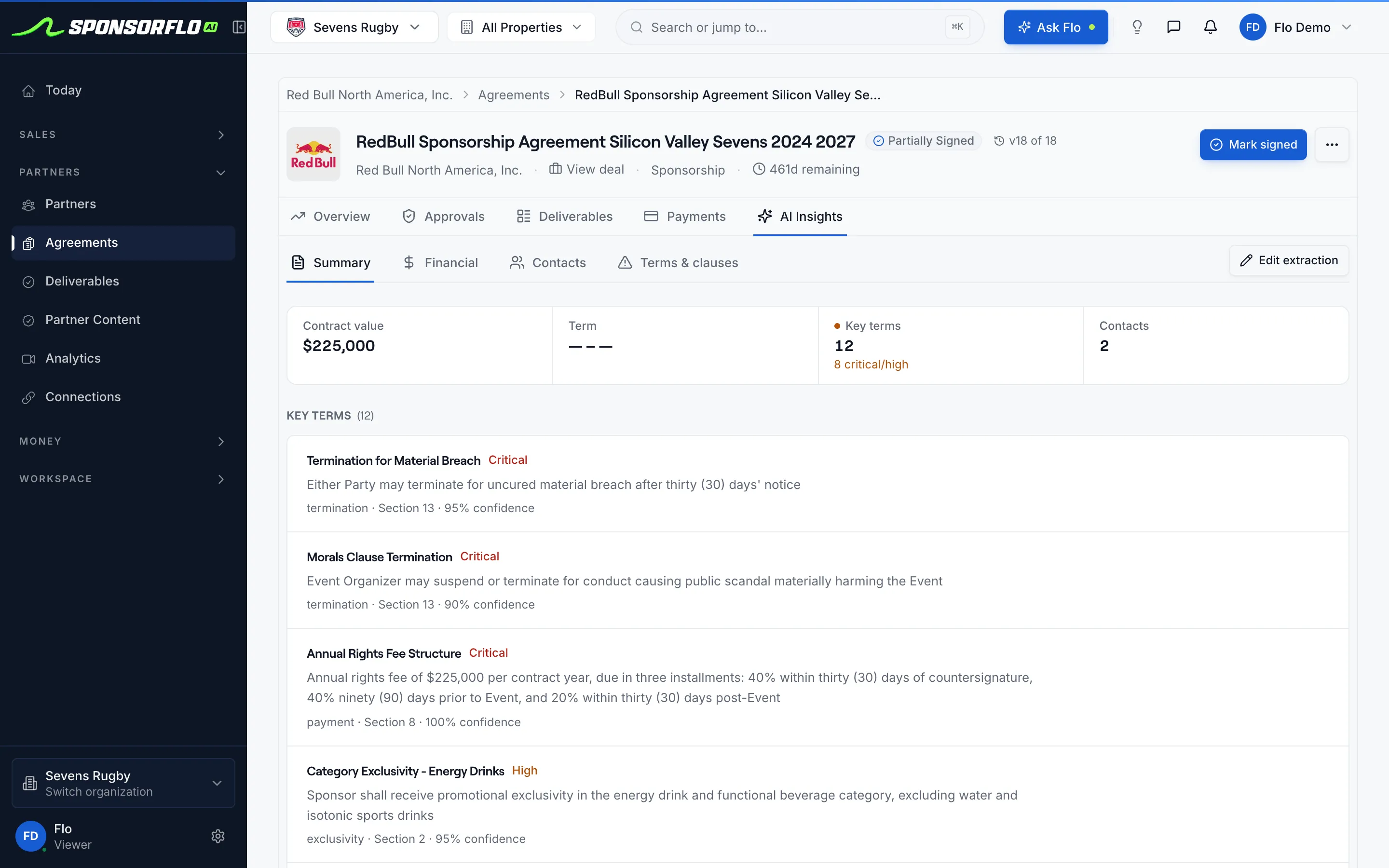
Start by getting the key terms out of the PDF and into a structured record your team can act on. In SponsorFlo, you upload a PDF or Word contract and AI extracts the term dates, fee, and deliverables into the agreement record. You confirm the sponsor and the deal before anything is created, then each deliverable lands on a draft agreement as a trackable line item with a status, ready for you to check. This replaces the common pattern of leaving the contract in an email attachment where no one checks it until renewal.
For example, a local event that sells a booth package, a logo on the event program, and four complimentary tickets would see each of those benefits extracted as separate deliverables. The ops team knows exactly what to deliver without rereading the PDF.
How to track sponsorship deliverables through fulfillment
Every benefit the contract promises should become a deliverable with a status, a due date, a priority level, and a place for proof. As the season runs, your team marks each deliverable complete and attaches proof: a photo of the jersey patch on the field, a screenshot of the social post with impressions, or a link to the podcast episode where the sponsor read aired. SponsorFlo tracks delivered impressions on each deliverable, so when renewal comes you can show the sponsor exactly what ran and how many people saw it.
The deliverables view shows completed, in-progress, and overdue items across every sponsor. Catching an overdue deliverable before the sponsor notices is the difference between a healthy partnership and a difficult renewal conversation.
How do you manage sponsorship payments and invoices?
Each agreement in SponsorFlo has a payments tab where you can draft invoices tied to the contract terms and collect payment through Stripe. If your finance team uses QuickBooks Online, customers, invoices, and payments sync both ways, so the sponsorship team and the accounting team are always looking at the same numbers. Invoice dates should match the payment clauses in the agreement, because your finance team will notice a mismatch faster than your sponsor will.
When should you start a sponsorship renewal?
Start the renewal conversation well before the contract term ends, ideally with several months of lead time. This gives the sponsor time to budget and gives you time to propose an upgrade backed by evidence. The renewal deck should reference every deliverable that ran during the current term, the impressions each one generated, and any media value measured from video analysis, not a blank template or a generic rate card.
Auto-renew and opt-out clauses are common in sponsorship contracts, and they catch teams that do not own the calendar. Set a reminder for the notice date in the agreement and assign a person to it. When the renewal window belongs to the whole team, no one watches it.
What to verify before signing a sponsorship contract
Before the agreement is final, walk through a short checklist that prevents the most common problems at fulfillment time. Confirm that the parties and authorized signers still match the contacts on the deal. Verify that term dates match your season or event calendar. Make sure the fee and payment schedule match the invoices you plan to send. Check that every deliverable in the contract matches the proposal deck, not vague language like "reasonable exposure." Only include exclusivity clauses if you can actually keep the sponsor category clean. And make sure termination terms are clear on both sides.
How to share fulfillment progress with sponsors
Sponsors should not have to ask whether their benefits are running. SponsorFlo’s partner portal lets sponsors view their deliverables and proof of performance through a shared link, so both sides see the same record without trading spreadsheets or scheduling a status call. When a sponsor can see that four of six deliverables are already complete with photos attached, the renewal conversation starts from trust instead of suspicion.
Sponsorship contract management for different deal sizes
The workflow is the same whether the deal is a two-page local sponsorship or a multi-asset season package. A local deal with a single booth and a logo placement still has a start date, a payment, and two deliverables to track. A larger package with a jersey patch, hospitality suites at six events, a podcast read series, and a social media campaign might have twenty deliverables spread across the season. In both cases, extracting the terms into a structured record and tracking fulfillment with proof keeps the contract from becoming a forgotten file.
Using AI to manage sponsorship agreements
AI helps at two points in the contract lifecycle. First, when you upload a signed contract, AI extracts the term dates, fee, and deliverables so you do not retype them. Second, Flo, SponsorFlo’s built-in assistant, can answer questions about your deals and agreements, such as which contracts are coming up for renewal or which sponsors have overdue deliverables. This turns contract management from a periodic review into something you can check on any day with a question.
- Contract templates — starting clauses and a checklist for sponsorship agreements
- AI Agreements — upload a contract and let AI extract dates, fees, and deliverables