A sponsorship package is a bundled set of deliverables — logo placements, booth space, social posts, hospitality, or ad reads — offered to a sponsor at a set price. The best event sponsorship package examples group those deliverables into tiered levels so each sponsor can pick the visibility that fits their budget. This guide explains how to structure tiers, set price ranges, and describe benefits so your packages close more deals.
Definition
Sponsorship package
A sponsorship package is a priced bundle of deliverables that a team, event, venue, or nonprofit offers to a sponsor. Packages are usually organized into tiers — such as Gold, Silver, and Bronze — where each tier includes a distinct mix of on-site signage, digital exposure, hospitality, and category exclusivity rights. A well-built package gives the sponsor a clear picture of what they receive, how many people will see their brand, and what the investment costs.
What should a sponsorship package include?
Every sponsorship package should include a tier name, a price, a list of deliverables, and a quantified reach estimate for each deliverable. Beyond those basics, strong packages also specify the term (per season, per event, annual), payment schedule, category exclusivity rights, and any hospitality perks such as VIP tickets or backstage access. The goal is to remove ambiguity so the sponsor can compare your offer to alternatives without a follow-up call.
- Tier name and price — use names that signal value (Presenting, Title, Headliner) rather than generic labels alone.
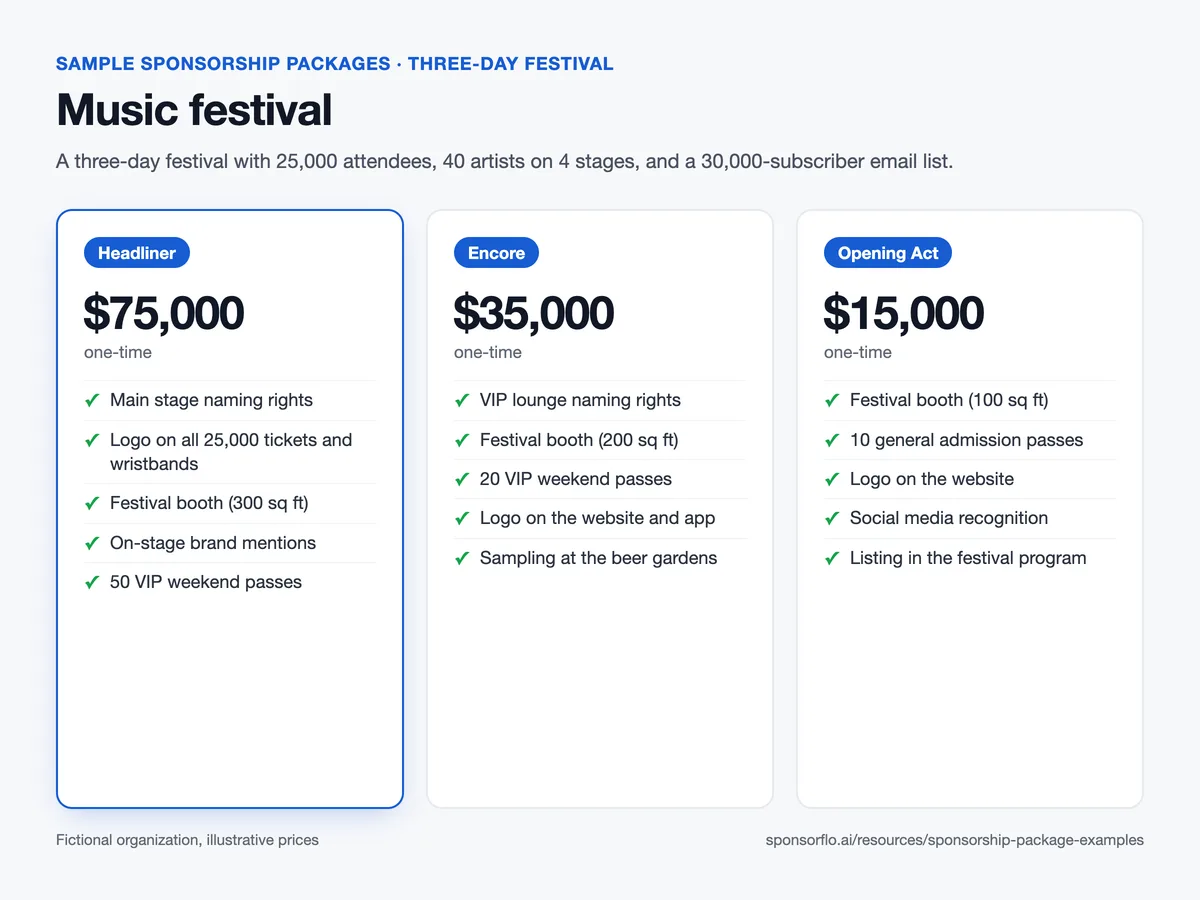
- Deliverables with quantities — "Logo on 25,000 wristbands" is stronger than "Logo on event materials."
- Reach or impression estimate — attendance, social followers, email subscribers, or broadcast audience.
- Term and payment schedule — per season, per event, annual, with installment options if applicable.
- Category exclusivity — state whether the sponsor is the only brand in their industry at that tier.
- Hospitality — VIP tickets, backstage passes, reserved tables, or suite access.
- Proof of performance — explain how you will document delivery, such as photos, analytics screenshots, or a recap report.
How do you structure event sponsorship package tiers?
Three tiers is a good place to start: the top tier sets the ceiling, the middle tier gives most sponsors a comfortable choice, and the entry tier lowers the barrier for smaller sponsors. The key is to make each tier qualitatively different rather than simply adding more of the same deliverable at a higher price.
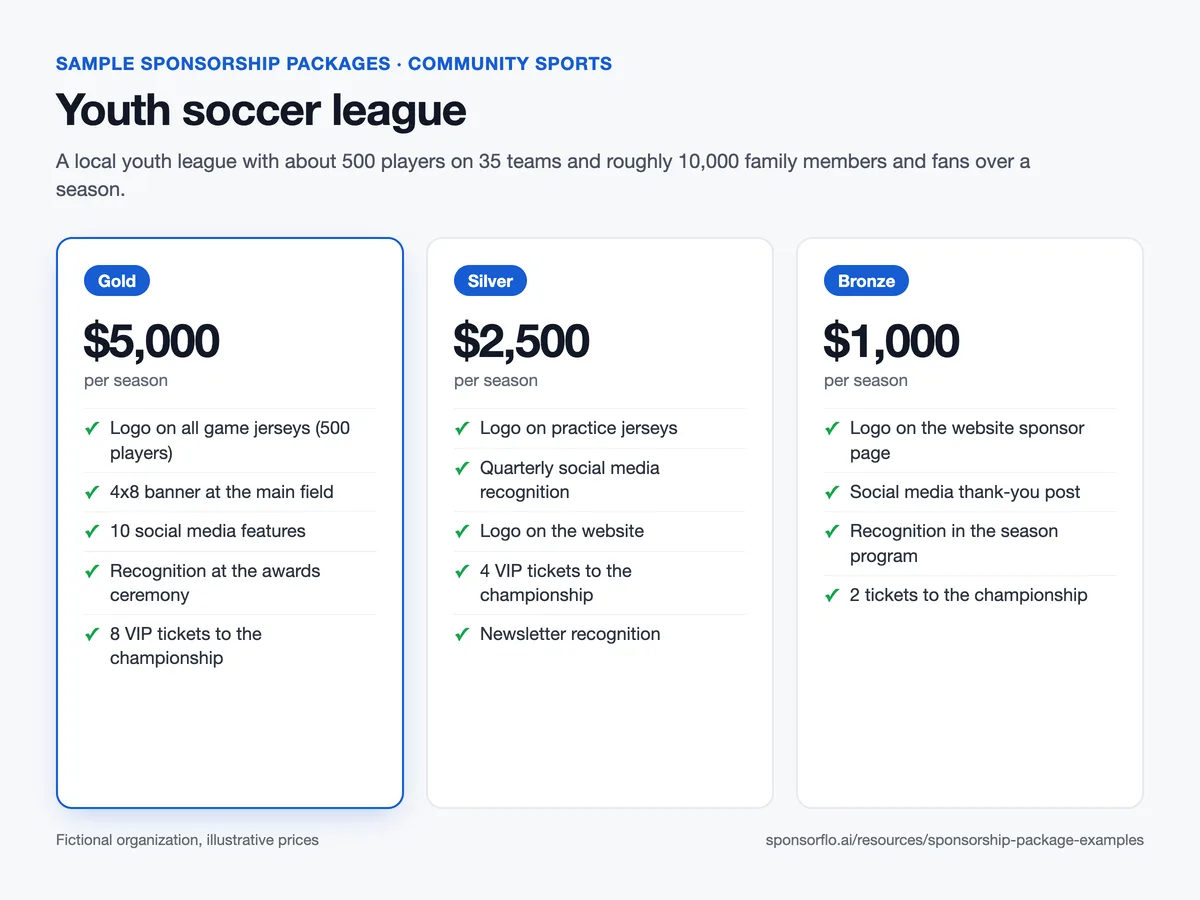
A youth soccer league, for example, might offer a Gold tier at $5,000 per season with jersey logos, a banner at the main field, social media posts, and VIP championship tickets. The Silver tier at $2,500 drops to practice jerseys and quarterly social recognition, while the Bronze tier at $1,000 includes only a website logo and a thank-you post. Each tier adds a visually obvious benefit — the jersey logo, the field banner — that justifies the price jump.
For larger properties, a fourth or even fifth tier can work if the top tier includes a genuinely unique benefit like naming rights, a keynote speaking slot, or a co-branded marketing campaign. Avoid adding tiers that differ only by adjective; sponsors will compare the middle tier to your top tier, and the jump needs to be visible.
How do you set pricing for sponsorship packages?
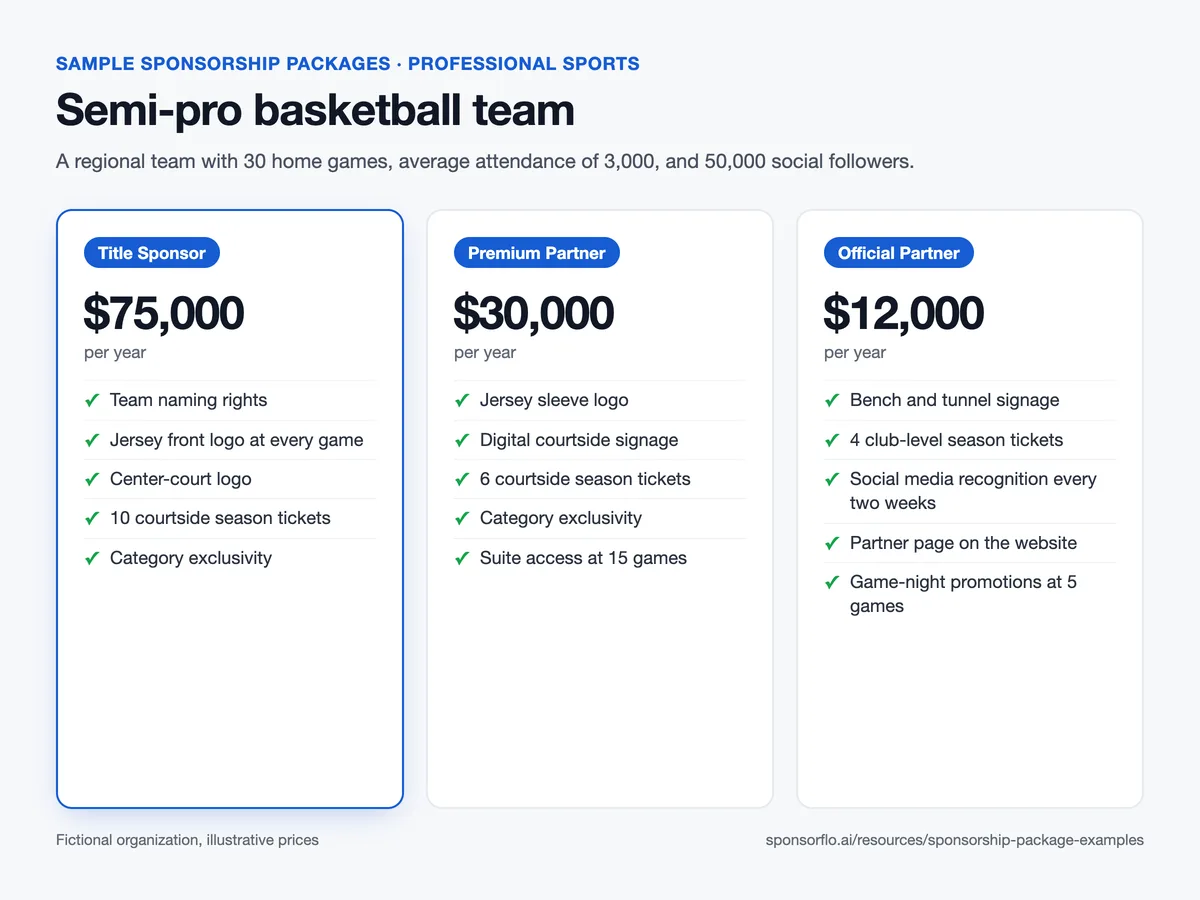
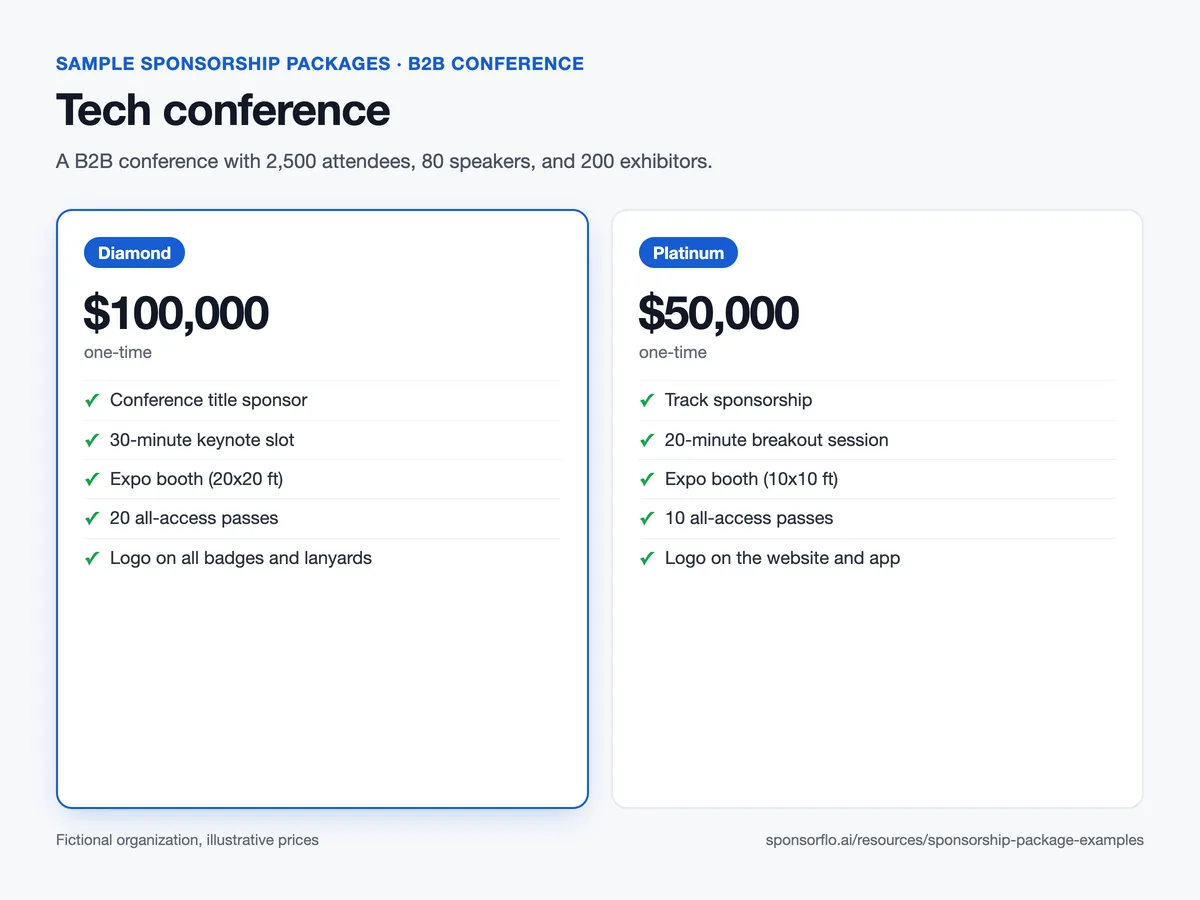
Pricing starts with the fair market value of each deliverable, then adjusts for your audience size, demographic quality, and competitive landscape. Typical price ranges vary widely by property type — a community sports league might price its top tier at $5,000, while a regional pro team's title sponsorship can reach $75,000 and a B2B tech conference can command $100,000 for a diamond-level package. These are sample ranges to adjust for your market.
Space the prices so each step up buys something the lower tier cannot get, such as the jersey front, naming rights, or a speaking slot, rather than a larger quantity of the same thing. Use the SponsorFlo pricing guide and CPM calculator to estimate fair values for individual deliverables like signage impressions, social media posts, and email mentions, then add them up to build each tier's total.
Sponsorship package examples by industry
The sample packages on this page cover six types of property — sports teams, events and festivals, schools, esports, creators and podcasts, and nonprofits — because the deliverable mix changes significantly across each one. Sports packages lean on jersey logos, field signage, and game-day hospitality. Festival packages emphasize booth space, wristband branding, and backstage access. Podcast packages center on host-read ads, newsletter mentions, and audience survey insights. Nonprofit packages highlight gala tables, program recognition, and access to a donor audience.
Sports team sponsorship packages
Sports packages typically anchor around on-field or on-court visibility because that is the deliverable sponsors value most. A jersey patch on 500 players in a youth league is seen at every game and in the photos parents share. At the semi-pro level, naming rights ("Your Brand Thunder") and courtside signage dominate the top tier because they deliver broadcast and in-arena impressions simultaneously. When building your own sports packages, count your attendance, broadcast reach, and social following separately and present each number on the package page.
Event and festival sponsorship packages
Events have a natural advantage: a fixed date creates urgency, and the attendee count gives sponsors a concrete audience number. The strongest festival packages layer physical activation (a 300-square-foot booth, sampling at a beer garden) with digital amplification (livestream integrations, email sends to the subscriber list). Conference packages can include lead generation deliverables like a pre-conference attendee list or a breakout session slot, which B2B sponsors value because they can tie the sponsorship directly to their sales pipeline.
Podcast sponsorship packages
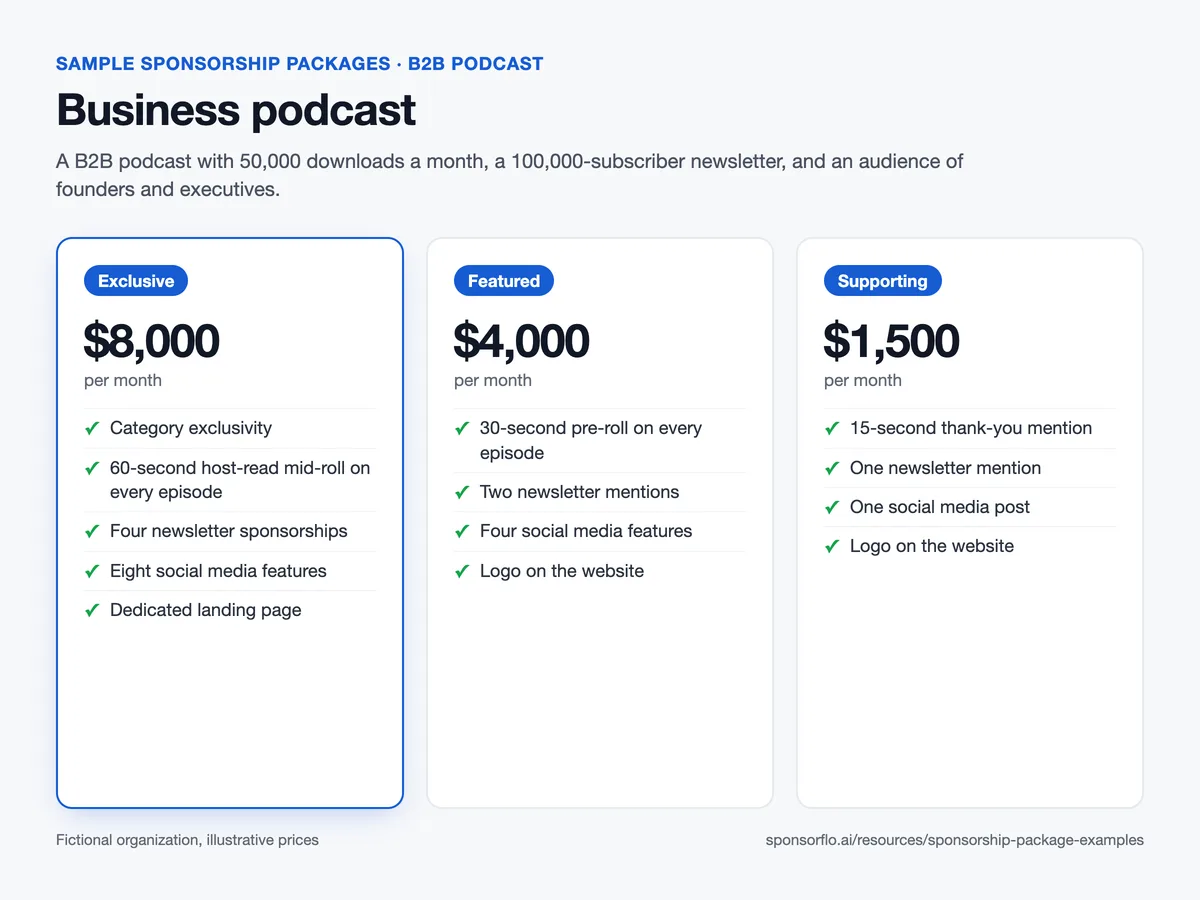
Podcast packages are priced around downloads per episode and newsletter subscribers because those are the metrics advertisers compare across shows. A host-read ad is worth more than a produced spot because listeners trust the host's voice, so the top tier should always include a host-read integration rather than a pre-recorded insert. Category exclusivity is especially powerful for podcasts because listeners hear only one brand in that space, making the association stronger.
School and booster club sponsorship packages
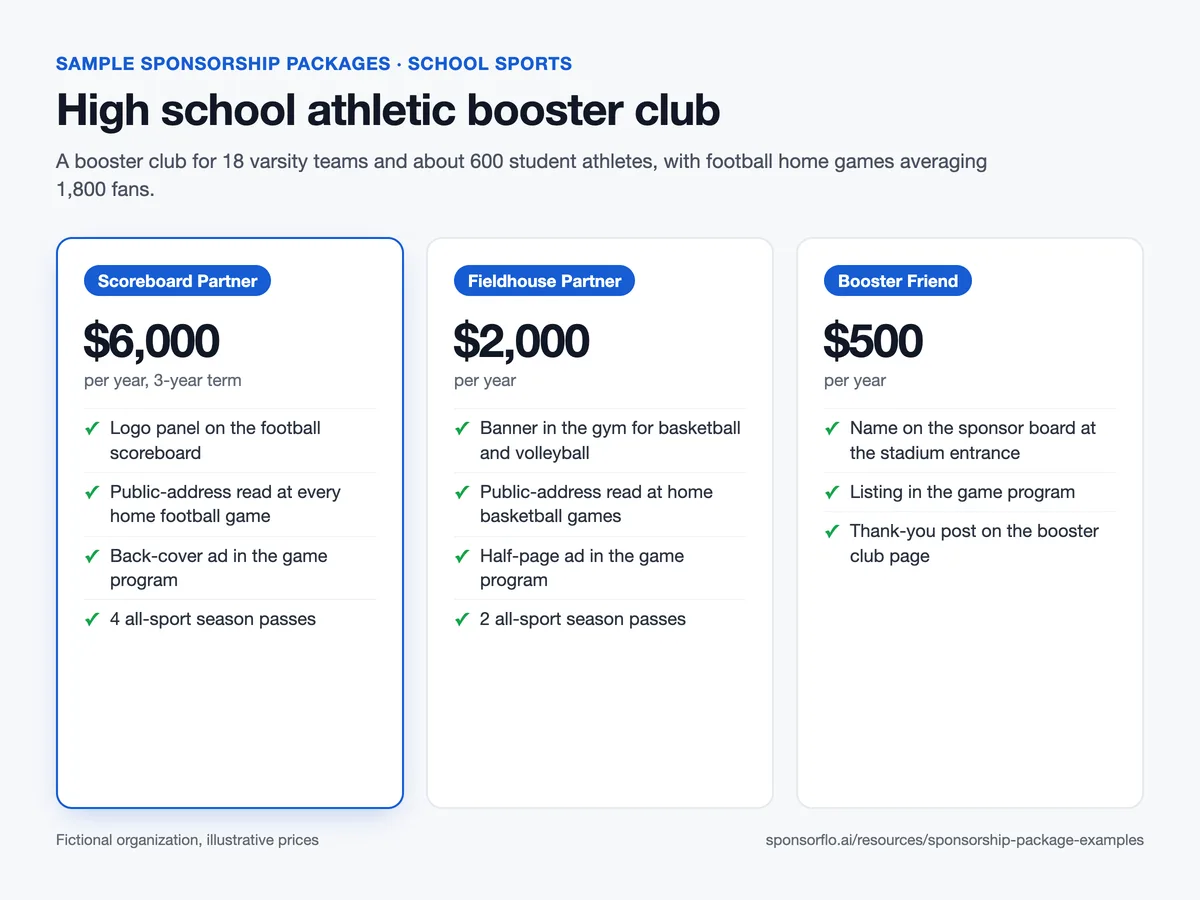
School packages sell season-long presence at home games: scoreboard panels, gym banners, public-address reads, and program ads. Because a scoreboard panel is built once, many booster clubs sell it on a multi-year term. Check your district advertising policy before you price signage, since some districts limit sponsor categories or require approval for every sign.
Esports sponsorship packages
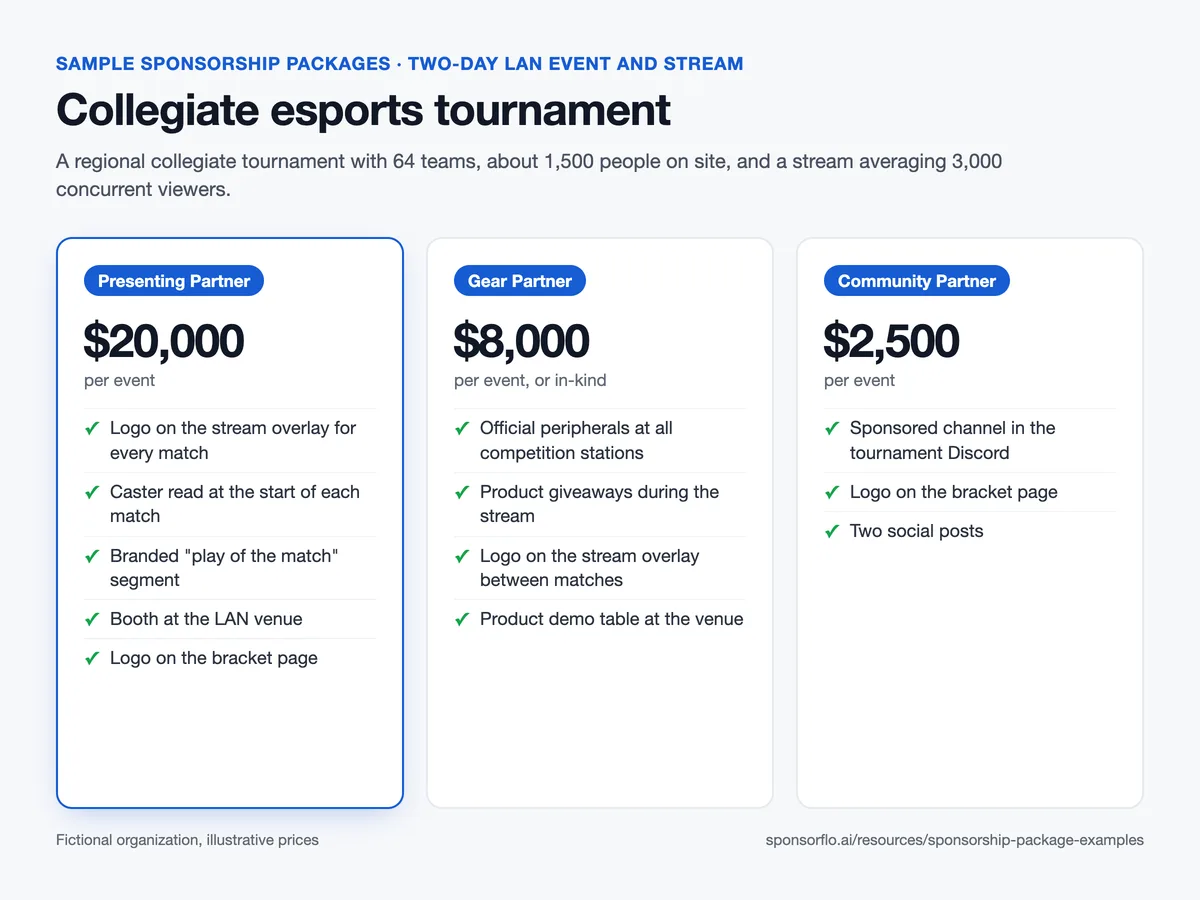
Esports packages are priced on stream viewership as much as the room. Report average concurrent viewers and hours watched from your streaming dashboard, then sell placements that live on the stream: overlay logos, caster reads, and a branded segment. Hardware and peripheral brands often prefer to pay in product, so an in-kind gear tier can fill a level that cash sponsors skip.
Creator sponsorship packages
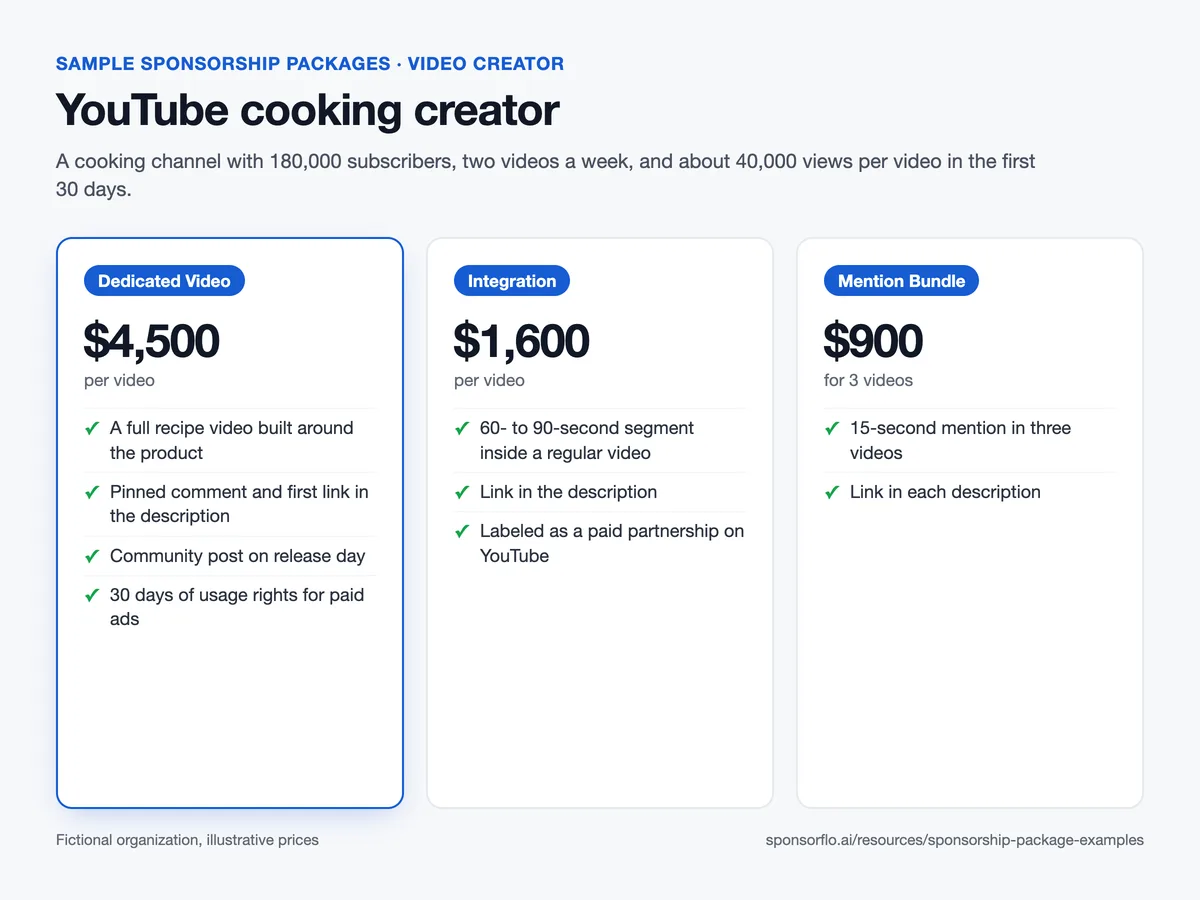
Creator packages are priced on views or downloads per video or episode, usually counted over the first 30 days. Dedicated content, an integrated segment, and a short mention make a natural three-tier menu. Price usage rights separately or build them into the top tier, and label every paid placement as an ad, as the FTC Endorsement Guides require for paid endorsements.
Nonprofit sponsorship packages
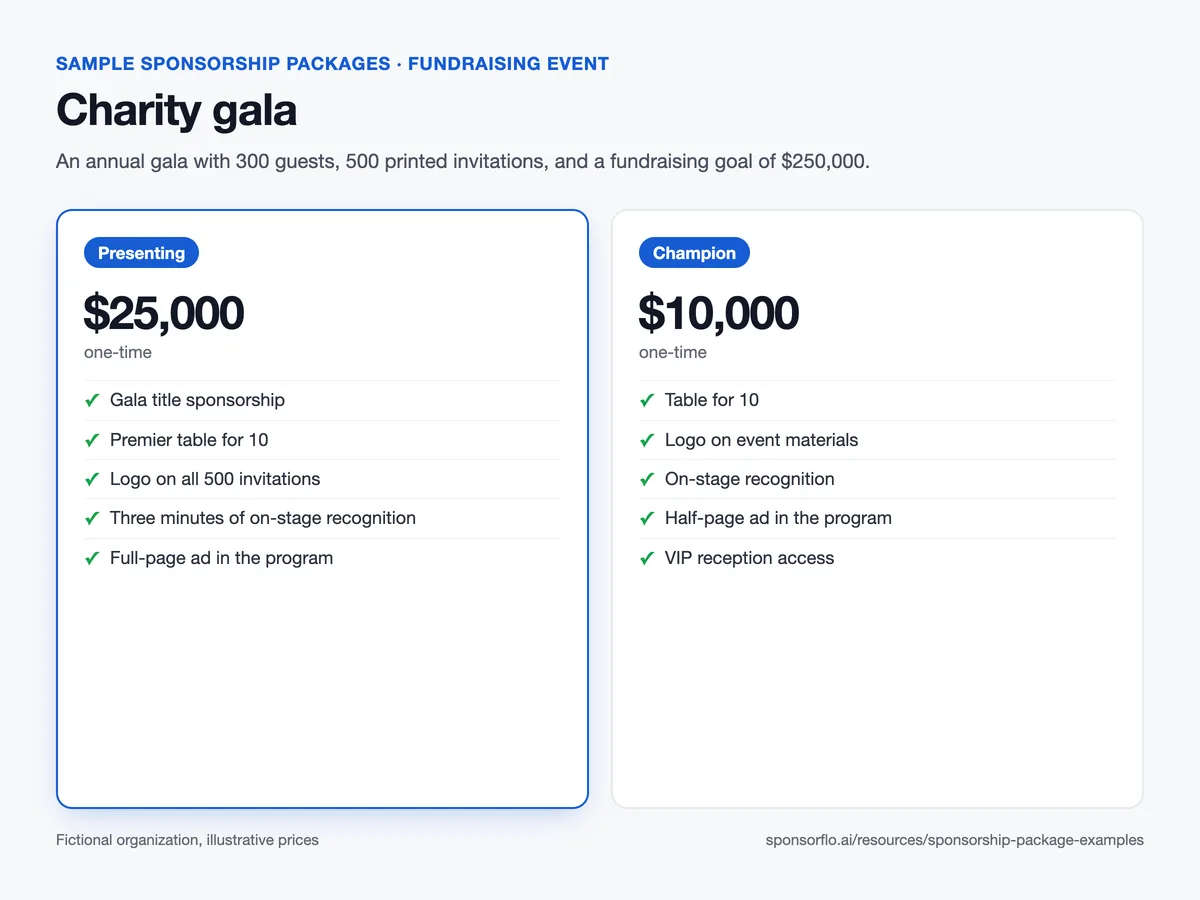
Nonprofit packages emphasize audience quality over audience size. In the sample gala, a $25,000 presenting sponsorship is priced on a room of 300 guests, stage time, and the invitation run rather than on raw impressions. When building nonprofit packages, highlight the demographic profile of your donor base, the recognition opportunities (on-stage mentions, program ads, press releases), and the alignment between the sponsor's brand and your mission.
How many tiers should a sponsorship package have?
Most sponsorship packages work best with three or four tiers. i4a's guide to event sponsorship packages, updated June 30, 2026, recommends three to four levels, because more creates decision friction and fewer can cap revenue. A small team or school can start with three and add a top tier only when it has a benefit nothing else includes, such as naming rights.
What is the difference between a sponsorship package and a sponsorship proposal?
A sponsorship package is one priced bundle of benefits, while a sponsorship proposal is the whole document that presents your packages to a sponsor along with your audience, the timeline, and the terms. The packages are usually one page of the proposal. A sponsorship packet or pack is a version of the proposal sent to many prospects at once.
What are common examples of sponsorship?
Common examples of sponsorship include a logo on a team jersey, naming rights to a stage or a venue, a booth at a festival or trade show, a host-read ad on a podcast, a dedicated video from a creator, a scoreboard sign at a high school stadium, a stream overlay at an esports tournament, and a table at a charity gala. Each one trades access to an audience for money or product, and each appears in the sample packages above.
Are these real sponsorship prices?
No. The organizations on this page are fictional and the prices are illustrative, chosen to show how tiers relate to each other. Real prices depend on your audience size, who that audience is, and what comparable properties in your market charge. The sponsorship pricing guide and CPM calculator walk through how to value each benefit.
How do you present sponsorship packages in a proposal?
The package page is typically one section of a larger sponsorship proposal or deck. Each tier should appear side by side so the sponsor can scan across columns and compare deliverables at a glance. Include a photo or mockup for each tier's most visible deliverable — a jersey with the sponsor's logo, a rendering of their banner at the venue, or a screenshot of a social media post featuring their brand. Visual proof of what the sponsorship looks like in practice is one of the strongest closing tools in sponsorship sales.
SponsorFlo's Deck Studio builds a branded sponsorship deck from your inventory and brand identity, generating sponsor logo mockups on your own asset photos so each prospect sees their brand on your jersey, banner, or stage. Each deck is personalized per sponsor with version history, and you send it as a tracked link that reports who viewed it and which pages they spent time on — so you know exactly who to follow up with.
How do you track deliverables after the deal closes?
Selling the package is only half the job; delivering every promised benefit and proving it was fulfilled is what earns renewals. Each deliverable should have a status, a due date, a priority level, and a proof attachment — a photo of the banner at the venue, a screenshot of the social media post, or a link to the newsletter. SponsorFlo tracks deliverables with status, due date, priority, delivered impressions, and proof attachments so nothing falls through the cracks. Sponsors can view their deliverables and proof through a shared partner portal link, which builds trust and makes the renewal conversation easier.
Common mistakes in sponsorship packages
The most common mistake is listing deliverables without quantities or reach estimates. "Social media recognition" tells the sponsor nothing about how many posts, on which platforms, or how many followers will see them. Always specify the count: "8 Instagram posts to 15,000 followers" is a deliverable a sponsor can evaluate.
- Vague deliverables — always include the quantity, platform, and estimated reach.
- Too many tiers with too little differentiation — three tiers with distinct benefits outperform five tiers that differ only by volume.
- No visual mockups — sponsors want to see what their logo looks like on your assets before they commit.
- Missing proof of performance language — state in the package how you will document each deliverable's fulfillment.
- Pricing without justification — show the audience size, demographic quality, or CPM basis behind each price point.
- Forgetting category exclusivity — sponsors pay more when they know a competitor cannot buy the same visibility.
From sample packages to a live pipeline
Use these sample sponsorship package examples as a starting framework, then adapt the deliverables, quantities, and price ranges to match your own property. Load your sellable assets into an inventory system with category, tier, price, and availability so you can build proposals quickly without recreating the list from scratch each time. SponsorFlo's inventory lets you manage assets with category, tier, price, availability, and packages, and supports CSV import so you can migrate an existing spreadsheet in minutes.
Once your packages are built and your proposals are out, you need a pipeline to track which deals are active, what they are worth, and when they are expected to close. SponsorFlo's pipeline tracks deals with stage, value, expected close date, and owner, and surfaces your open pipeline value, won deals, and win rate so you always know where your sponsorship revenue stands. When a deal closes, the agreement module lets you upload the signed contract, and AI extracts the terms and deliverables so fulfillment tracking starts automatically.