Calculate your sponsor lifetime value
Enter a sponsor's annual deal value, renewal rate, expected growth, and what it cost to win them, and the calculator shows the total value of the relationship, year by year, over the time horizon you choose.
Your sponsor
Average annual sponsorship value.
Probability the sponsor renews each year.
Expected annual increase in deal value.
What it cost to win this sponsor.
LTV results
Enter your sponsor's numbers to see the long-term value of the relationship.
How does the sponsor LTV calculator work?
Each year counts the annual deal value, grown by your growth rate and weighted by the chance the sponsor is still renewing; lifetime value is the sum of those years, and net LTV subtracts the acquisition cost.
How do you increase sponsor lifetime value?
You increase sponsor lifetime value by raising annual value, improving retention, growing each sponsor's investment over time, and lowering what it costs to acquire them.
Increase annual value
Upsell additional services and premium packages.Improve retention
Focus on relationship management and ROI delivery.Drive growth
Help sponsors expand their investment over time.Reduce acquisition cost
Streamline the sales process and leverage referrals.
What keeps sponsors renewing
- Strong relationship management, with dedicated account management and regular check-ins
- Proven ROI delivery, consistently delivering measurable returns
- Exclusive benefits, such as category exclusivity and premium perks
How the deal is structured
- Multi-year contracts with longer initial terms
- Performance bonuses and incentive-based pricing models
Sponsor Lifetime Value (LTV)
Sponsor lifetime value is the total revenue a single sponsor generates across every year they remain a partner. You calculate it by multiplying average annual sponsorship revenue by the average number of years the sponsor renews, giving you one number that shows whether your retention efforts are paying off and how much you can afford to spend acquiring new sponsors.
Sponsor lifetime value (LTV)
The total revenue one sponsor contributes over the entire duration of the partnership, calculated as average annual sponsorship revenue multiplied by average retention in years.
How do you calculate sponsor lifetime value?
You calculate sponsor lifetime value by multiplying the average annual revenue a sponsor pays by the average number of years that sponsor renews. For example, if three sponsors each pay an average of $8,000 per year and stay for two years, the LTV of each sponsor is $16,000. The calculator on this page lets you model that math with your own numbers, so you can compare scenarios quickly without building a spreadsheet from scratch.
Start with the numbers you already have. Export past seasons from your deal records or budget sheet before relying on any calculator default. One year of data gives a rough estimate, but three seasons reveal a pattern you can present to your finance team with confidence.
Why does sponsor lifetime value matter?
Sponsor lifetime value tells you how much a relationship is actually worth over time, not just in one contract cycle. When you know LTV, you can set smarter acquisition budgets, prioritize renewal conversations with the highest-value partners, and justify investment in hospitality, activation, or proof of performance that keeps sponsors coming back.
LTV also helps you spot trouble early. If the lifetime value across your portfolio is trending down, that usually means retention is falling or deal sizes are shrinking — both problems you can address before they compound.
What improves sponsor lifetime value?
The most reliable way to raise LTV is to increase how long sponsors stay. Retention improves when sponsors can see what they received for their investment. Sending a recap that shows delivered benefits — impressions, logo placements, hospitality appearances — gives your contact something concrete to share with their own leadership at renewal time.
- Deliver proof of performance after every activation, including photos, impression counts, and media clips, so sponsors never have to guess whether the partnership worked.
- Offer packages that include benefits sponsors actually use, such as hospitality suites, booth space, or digital placements, rather than padding a package with items that go unused.
- Start the renewal conversation early, ideally 60 to 90 days before the current agreement ends, so you are in front of the sponsor before their budget is allocated elsewhere.
- Track upsells only when they are signed, because verbal commitments should not go into your LTV model until they become real revenue.
How do you segment LTV by sponsor category?
Segmenting lifetime value by category gives you a clearer picture than a single blended average. A regional bank and a local pizzeria rarely renew on the same timeline or at the same dollar amount, so combining them into one number hides what is really happening in your portfolio.
Group your sponsors by industry or tier and calculate LTV for each group separately. You might find that healthcare sponsors average a three-year tenure while restaurant sponsors average eighteen months. That insight shapes where your prospecting time goes and which categories deserve a more aggressive renewal strategy.
What is the difference between booked LTV and cash LTV?
Booked LTV is the total value of signed agreements over the life of a sponsorship, while cash LTV reflects what you actually collected. If some sponsors consistently pay late or short-pay invoices, your cash LTV will be lower than what the contracts promised. Weighting annual fees by your collection rate gives a more honest number to plan against, especially when you are forecasting revenue for a future season.
How should you handle churned sponsors in your LTV calculation?
Churned sponsors pull your average LTV down quickly, which is why understanding why they left matters as much as the number itself. Record the reason a sponsor churned — budget cuts, poor activation results, leadership change — so you can avoid repeating the same issue with the next prospect in that category. Over time, tracking churn reasons reveals whether the problem is your packaging, your follow-through on deliverables, or factors outside your control.
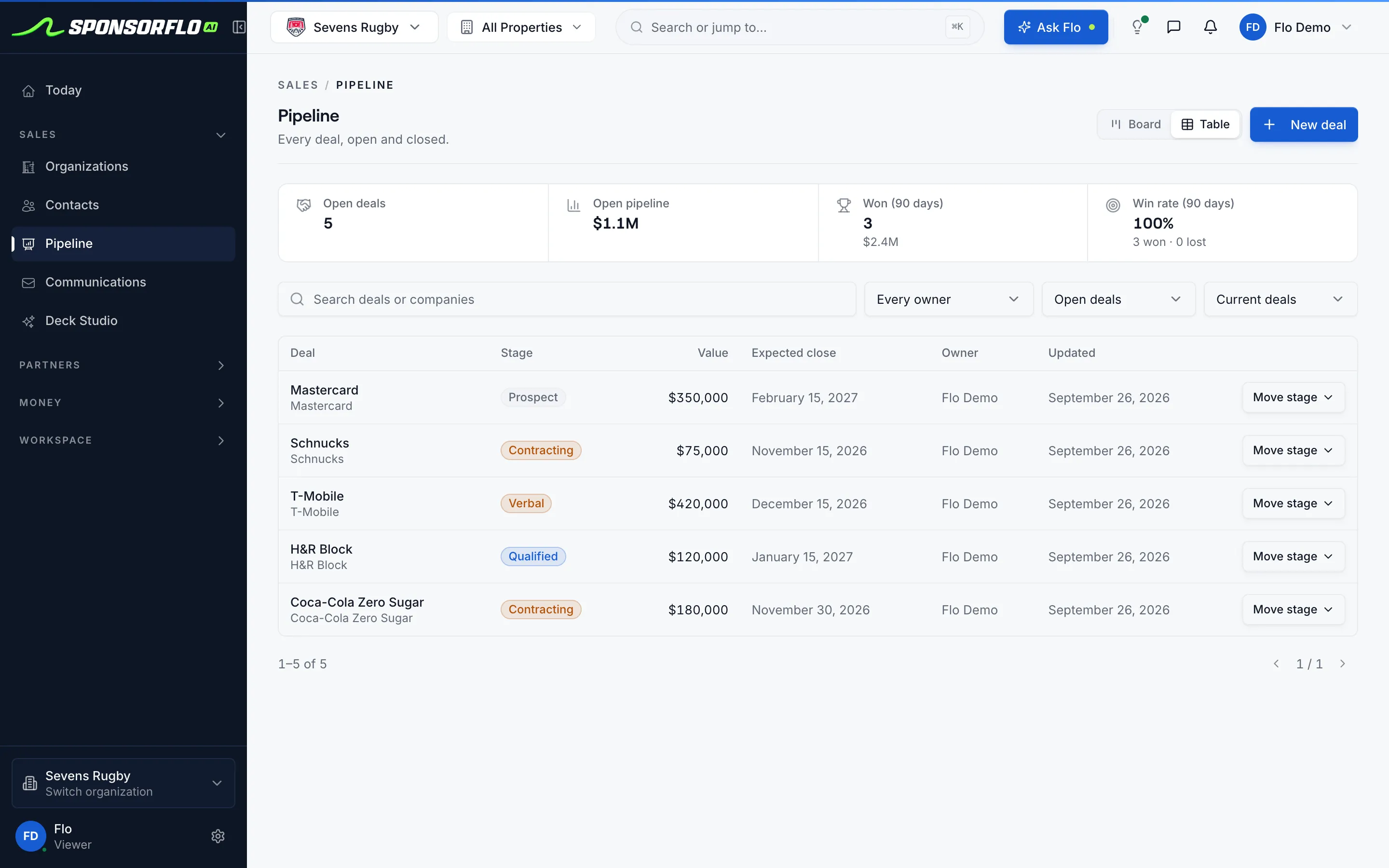
SponsorFlo tracks every deal with its stage, value, and outcome, so you can see win rates and spot where sponsors are dropping off in your pipeline. Pairing that pipeline data with deliverable tracking — where each benefit has a status, due date, and proof attachment — gives you the retention inputs you need to keep LTV moving in the right direction.
- Sponsor retention strategies guide — A deeper look at renewal workflows and how to keep sponsors longer.